Monday, 25 October 2021

The Day The World Turned

My short story titled "The Day The World Turned" has just been published in the anthology, No More Heroes, edited by Ian Whates, and as usual I'm writing a few words discussing how the story came to be written. There may be spoilers within.

I was invited to contribute to this anthology which wanted SF/F stories inspired by artists who have left us too soon. If the remit was given now, I would probably have chosen The Stranglers' keyboard player, Dave Greenfield, who unfortunately died of a Covid-related illness in 2020, however this anthology has been a while in the making and those circumstances had yet to pass. This isn't to detract from the chosen subject of my piece, the singer Poly Styrene from X-Ray Spex, whose album, "Germfree Adolescents", is in my top five records of all time.


Poly unfortunately died of metastatic breast cancer on 25th April 2011 aged only 53. I wanted my story to reflect the breadth of her life, from childhood through to punk through to Hare Krishna convert. In particular, I wanted to build on her experience of seeing a UFO after leaving a gig in Doncaster in 1978, which had a profound effect. Poly felt objects crackling when she touched them, and believed she was hallucinating. I thought it would be interesting to focus on this incident, when reality changed, when something beyond music called to her. Riffing off the song title, "The Day The World Turned Day-Glo", I thought "The Day The World Turned" to be a fitting title for this piece.

My piece isn't meant to be entirely factual, but I hope I've caught the spirit of Poly and her influences in my story. The story is chock-a-block with instances and references to Poly and the time period which I hope the casual reader will appreciate, but which will also spark like beacons to dedicated fans. 1976 was a leap year. Indeed.


Here's an extract: Stagelights backcomb her hair as a dandelion clock. She turns and notices her shadow against the wall by the mixing desk. A curious excitement pitches her insides. Live music is really something. She is fifteen again – squatting, shotting. Within the darkened environment – challenging the sun which will hang fire another one hundred and fifty minutes – distinctions are levelled. Everyone is here for one thing. Camaraderie in numbers.

I usually listen to music when writing a short story, and of course in this instance I wrote whilst playing  the album "Germfree Adolescents" from X-Ray Spex on repeat. For further reading, you might also want to check out Unconscious Consumer: X-Ray Spex and the Day-Glo World that I wrote for Sein Und Werden magazine in 2015.


No More Heroes is published by PS Publishing and retails at £25.00 in jacketed hardcover and £35.00 as a signed limited edition hardback. Contributors (including their subjects) are Keith Brooke [Amy Winehouse], Ren Warom [Freddie Mercury], Tim Lebbon [Phil Lynott], Storm Constantine [Leonard Cohen], Alison Littlewood [David Bowie], Stephen Palmer [Edgar Froese], Gavin G. Smith [Lemmy Kilminster], Maura McHugh [Dolores O’Riordan], Michael Cobley [Allen Lanier, Sandy Pearlman], Allen Ashley [Robin Gibb], Vaughan Stanger [Steve Strange], Neil Williamson [Jon Lord], Jaine Fenn [Glenn Frey], Adam Roberts [Rick Parfitt], Una McCormack [Dave Swarbrick], Martin Sketchley [Pete Burns], Andrew Hook [Poly Styrene], Bryony Pearce [Prince], Ian Whates [Chris Squire], Donna Scott [Chris Cornell]. Buy your copy here.

Finally, "The Day The World Turned Day-Glo":


Tuesday, 19 October 2021

Head Shot Press

So I've decided to set up my own crime publishing company to not only re-publish some of my older crime novels and new work, but also to create the opportunity for other crime writers to join me on the same journey. The result is Head Shot Press. The focus will be on paperbacks and e-books, with the first five titles now available. As these are all my books so far, I wanted to explain why I've gone this particular route.


It was in 2004 that I wrote my first crime story, "Alsiso", which was published in the British Fantasy Society award-winning anthology, "The Alsiso Project", which was also edited by myself. "Alsiso" introduced Mordent, my ex-cop turned PI who sees the world through noir-tinted glasses and has a bubblewrap fetish. Being a fan of Raymond Chandler (who admittedly is more hard-boiled than noir) I wanted a PI who utilised all the descriptive prose associated with the genre, coupled with wise-cracks, black humour, etc, whilst also telling a good story. Following "Alsiso", whenever I had an idea for another crime short story it made sense to use the same PI. As such, after four or five stories, I realised I had the springboard for a novel, and shortly thereafter I wrote the first in the series, "The Immortalists", which - together with the second in the series, "Church of Wire", was sold as a two-book deal to Telos Publishing with these appearing in 2014 and 2015 respectively.

Telos (the team of Series Editor Samantha Lee Howe, together with David Howe and Stephen James Walker), did an excellent job editing those two novels, sourcing some appropriate artwork, and doing their best to promote the books accordingly. Meanwhile, I wrote a couple of other Mordent novels, "People I Know Are Dead" and "The Happy Finish". However, as the first two books didn't sell as well as Telos were hoping, they decided not to offer a deal for those latter titles, and after a while the rights reverted to me and I decided to retain them.


With the rights to all four books back in my possession, I made concerted efforts over the next few years to sell them again. The difficulty being that few publishers seemed interested in a series which hadn't quite taken off, which had stalled at the midway point, or they weren't keen on taking on the two latter novels if it meant they would also need to reprint the first two. Whilst I had a lot of good feedback about the quality of the prose, it became increasingly likely I would never sell them. So I parked them for a while - usually waiting to hear from some publisher or another - but never really wanted to abandon them.

You see, I have a great affection for Mordent. He can be bullish, immoral, misogynistic, but also funny, intelligent, and astute. I liked his sexual exploits as much as I liked the crimes he was embroiled within. He's fallible, for sure, anachronistic, fighting against the tide. He longs for the days when dames were dames and noir was in its heyday. Yet he also realises those days never existed outside of celluloid, remaining content to live his life as though they did. So I decided to re-read the books and see how I felt about them. I realised that I very much wanted to see them in print even if only a dozen people read them. I decided to go it alone.


In re-editing the first two books I made a couple of 'author's preferred edition' notes. Because "The Immortalists" (and to some extent "Church of Wire"), had been built on those previously written short stories, they had been included as background material woven within the novels. In writing those longer works, the short stories had given me a leg up, but in hindsight I saw they dragged the plots down. So I pulled those stories from the novels, and together with other Mordent stories I've written since, decided to create another book. "Dead Time" is a one hundred and fifty page collection of Mordent stories which sits well alongside the novels in its own right. I also had been convinced by Telos to have a prologue in "Church of Wire" as a teaser for the novel, an action scene that was pulled from the middle of the book. In this Head Shot edition, I've restored it and removed the prologue. I was never totally happy with the decision - although respected the business sense of it - and when one reviewer had picked up that they thought the prologue unnecessary I found I was inclined to agree with them. Those two novels have therefore been edited for these editions.


In rebranding the novels I decided not to simply go the Amazon route for self-published paperbacks, but having already run an award-winning publishing company (Elastic Press, from 2002 to 2009), I knew I wanted to also publish other writers, in particular, Andrew Humphrey, whose crime writing I have always admired and whose two short story collections I had published with Elastic Press. I knew I could work with him on some longer works that he had squirreled away. So the game was afoot.

Even so, it was a couple of years with the idea at the back of my mind before I decided to run with it in 2021. I had the name of the press, Head Shot, for a while, and liked it. I wanted the books to look as 'crime' as possible, so anyone scanning the covers would assume the content. But finding artwork for five titles which might clearly identify them as a series and which had some kind of unity of theme wasn't obvious. After abandoning a few ideas, I had the thought of using one piece of artwork which might work as the cover for all the books. Artwork which - if the titles were laid side by side - would create one picture. Bearing in mind the 'noir' and 'city' theme it was a quick google search to find an appropriate cover. An excellent piece of art that was the composite of several cities and so not tied to an obvious location, which dripped with noir. Contacting the artist, Edouard Noisette, we negotiated terms and the piece was obtained.


I paid particular attention to fonts and colours. In my Sunday library job a lot of crime books pass through my hands and I got a feel for how they should be presented. I selected a font by scanning covers into a program which could determine which fonts were being used, and I selected the colours by also watching trends with recent titles. The back covers for the print options were also suggested by templates from a variety of publishers. The logo is simple, basic. I think the cover captures the feel of the book without over-explanation, something that I've been guilty of in the past when offering artwork ideas. Even if the stories are different from the norm in crime, I wanted them to look the same.

In the end, I've produced five books which I'm exceptionally proud of, which I think could sit on a shelf and be identified as crime, and hopefully will catch the eye with a reader. Maybe even with two readers. Truth be told, these might not sell and I might have spent much of this year riding a white elephant. But I'm glad I chose this option and I'm happy the books are now out there. I'm now looking forward to reading what other work might be sent my way (from writers who read the guidelines first).


All books are available through links on the Head Shot website. Alternatively, a quicker route to the Kindle versions can be found here

Saturday, 9 October 2021

Messier 94

My short story - co-written with Eugen Bacon - titled "Messier 94" will shortly be published in her collection, Danged Black Thing, and whilst I usually write a few words discussing how a piece came to be written it seemed to make sense to suggest to Eugen that she guest writes this post. The book is available for pre-orders now.

Before I introduce her, however, it's worth mentioning that Eugen 'discovered' my writing through my collection, "Frequencies of Existence" (NewCon Press) which she had been sent to review. Her reaction from that book was that she asked if I could write a blurb for her short novel, "Ivory's Story", also being published by NewCon Press. Although I agreed, initially I was wary of entering into a potential back-scratching situation, however after having read "Ivory's Story" not only did I want to write a blurb, but a full review which I then placed in Black Static magazine. At the conclusion of that review I wrote that the novel was "a fast-paced organic fantasy shone through a poet’s timbre and I loved it." From this, her suggestion that we collaborate felt like an exciting prospect.


Anyways, here's Eugen's take on "Messier 94":

Writing an Unamed Story with Andrew Hook

I’d finished reading Andrew Hook’s short stories in Frequencies of Existence, Human Maps, The Forest of Dead Children and The Alsiso Project, and was hooked.

I was also fresh off collaborating on a short story with Seb Doubinsky, and had previously written with E. Don Harpe and Dominique Hecq, so writing with others was not a novel thing for me to do. And I was already nuts about Hook’s way of saying, how his mind takes him.

Would you… might you… I broached nervously.

‘A collaboration sounds like fun and something I’d definitely be interested in,’ he surprised me with his response. ‘Do you have any specific ideas?’

I didn’t.

‘When I’ve done it before,’ he said, ‘it was a case of taking turns with the other writer, adding 500-750 words or so and then sending it back and forth until the story was finished.’

Yes! I loved it.

‘Looking forward to seeing the start of the collaboration,’ he said, leaving me in a mixture of trepidation and ecstasy. What the hell were we going to write?

I opened a folder named ‘working with Andrew Hook’.

And started typing:

An Unnamed Story

By Andrew Hook and Eugen Bacon

I was passing through an altered line-up of suspects removed from linear time, but none revealed their wind or percussion, not even a state of mind. What I needed was a shift that happened inside out, outside in, something fixated on call and response. What I needed was a zoom, possibly in never out…


I wrote 908 words, to be exact, including a header that stated:

Eugen Bacon & Andrew Hook         about xyz words


The excerpt finished with:

I caught a whiff of cinnamon, muffins freshly baked. Something burnt and nutty: coffee perhaps.


“Will that be all?” piped a voice.


I sank on the bed, too miserable to tip the child—the child!—perhaps a teenager, wearing curls on his head, a tux and a bowtie and the big eyes of an adorable puppy. I put my head in my hands, stared at my feet as the door softly closed. 


The blood on the door and the carpet was gone.


Hook took a few days, perhaps a week, came back with a response—433 words. I loved how he’d picked up the story and connected with where he was going:

*

Dr X was an intriguing nom de plume, an inescapable lie. Regardless of a shifting perspective which nagged at my psyche, I had recollections – memories, education – which scrolled through my mind like a zealot through microfiche. Data, sensations, visions, dislocations formed information I knew and moments I had lived. In addition, those strong breakfast smells suggested baseline reality. Whilst forcing a construct upon my malleable environment, I found I could operate within different parameters. I watched my fingers mutate in the process of extending, reaching for a muffin which changed shape before my eyes. My conclusion defaulted to virtual reality, yet when the muffin reached my mouth there was no sensation of falsehood. The texture was as authentic as the taste. Perhaps it was more likely any hallucinations were narcotic in nature, as opposed to an exterior simulation.


My keenness soared. Especially when I read this part where Hook wrote:

I was reminded of a galaxy, Messier 94, itself an anomaly within others of its kind. Unlike regular spiral galaxies which were a disk of gas and young stars, intersecting a large sphere of older stars, Messier 94 did not contain such older stars. Instead a bright central structure held intense star formations which resembled a bulge forming a ring around the central oval region.


So I named the next draft of ‘An Unamed Story’ to ‘Messier 94’, and sent Hook the next iteration. He replied with more words. And thus it was, back and forth, back, forth. What struck me about Hook is how he sent back polished drafts. His email would be something like: '...been busy... found a minute... hope you like it...' And it would be a perfect write. Where I fiddled and fuddled, moved things around, edited, edited... Hook took a minute on his computer, quickly read through the story so far, and then punched something polished straight from his head. 

Sometimes the story appeared to spiral, and I worried we might be unable to contain it. But it always aligned itself. Finally, I sent Hook what I thought might lead to a neat closing.

He replied in a few days. ‘Here’s our collaboration. Added 774 words,’ he said. ‘Worked it back around (I hope). Feel free to conclude.’

The conclusion became a few iterations of tweak and refine, v0.4ah, v0.4 ah eb, v0.5, v0.5ah…

Finally, we had a story, 5,300 words of slipstream fiction that made perfect sense, and didn’t. It was awesome.

‘Messier 94’ is the eighth story in Danged Black Thing, out in November 2021 by Transit Lounge Publishing and available now for pre-order. I am excited to hear what critiques think about this particular story—already they’re talking good things about the collection that also features stories with Seb Doubinsky and E. Don Harpe—all collaborators in a potentially unclassifiable single-author/multi-author collection/anthology that should be a publisher’s nightmare, but so far isn’t!


Monday, 27 September 2021

The Redeemers

My short story titled "The Redeemers" has just been published in the anthology Ars Gratia Sanguis, edited by Steve J Shaw, and as usual I'm writing a few words discussing how the story came to be written. There may be spoilers within.

I was invited to submit to this anthology where the theme was for horror stories to be based upon a work of art - either real, or imagined. Initially I considered a piece of performance art, possibly by Marina Abramović, but then I gravitated towards a piece which I'd seen at the Liverpool Tate Modern quite some time ago, but which had always resonated with me. That piece was "The Redeemers", created by the artist John Davies.

As you can see from the above, there's an interesting dynamic happening here. The covering on the male's head is disconcerting and somewhat sinister. I also like how the figures lean into one another, as though conferring. I wasn't quite sure how I was going to approach my story, but I had a starting point; and whilst I generally use my own titles for fiction, I felt the original title would also suit my story.

Considering the artist was still alive - and whilst perhaps unlikely to read my story - I wanted to reach out to check he was happy for me to use it as a springboard, but also to discover if there was any particular meaning I should know about. I received an enthusiastic reply from John Davies which I'm sure he won't mind me including here: "I have always been reluctant to explain my work as I have confidence in the onlooker to be creative, as we all are in our imagination. I liked the mystery of creating an enigma for people to puzzle over, like witnessing something on the street and not being able to stop and interview the people." Wholeheartedly agreeing with this, and having John also giving me the go ahead, I began to think how I could incorporate the piece in the story.

Deciding that I didn't want to impose meaning on someone else's art, even with their permission, I decided to have the artwork as a catalyst for my main character. I had read about Stendhal syndrome, a psychosomatic condition where a person might experience rapid heartbeats, fainting, confusion and even hallucinations, allegedly after being exposed to artworks. Suddenly I had the basis for a story, whereby my main character becomes obsessed with recreating the feeling he first gets upon seeing The Redeemers. Becoming subsequently banned from the gallery, he seeks other ways to satisfy this obsession...


Having written the piece, I emailed it over to John Davies for his opinion. I don't know what he was expecting, but I was happy with his reply: "I've read your story, and may not sleep tonight! Quite a riff on my 'Redeemers' and you have certainly let rip with YOUR creativity. Naturally, it's uncomfortable for me to read; imagining if they were affecting a real person in this way would be quite a responsibility -- so I am trusting it's all a fiction that your readers will enjoy!"

Incidentally, I always write stories with music on a loop in the background. In this case, it was the album "Felt Mountain" by Goldfrapp.

Here's an extract: From that instance in his bedroom, it subsequently proved impossible for Bates to not see the redeemers. At the supermarket, in the benefits office, in public toilets, on the street, in field, forest and sky. Their presence was everywhere: enigmatic and enduring. Even when Bates closed his eyes he found their image burned onto the back of his lids. Always unmoving, always perfectly rendered, always real. Through repetition, however, his reaction had numbed: the greater the interaction, the less of an impact. He could barely hide the comparison to other relationships, where initial mystery and expectation becomes relegated to routine and conformity. The inexplicable reaction he had first experienced at Tate Liverpool was now a dim memory, as faded as his first job, his first house, his first love.


Ars Gratia Sanguis (Great British Horror 6) is published by Black Shuck Books and retails at £11.99 in paperback and £20 as a limited edition hardback. Contributors include Steve Duffy, Brian Evenson, Helen Grant, Muriel Gray, Sean Hogan, Andrew Hook, Sarah Lotz, Lucie McKnight Hardy, Teika Marija Smits, Lisa Tuttle and Stephen Volk. Buy your copy here.

Monday, 23 August 2021

Caboose

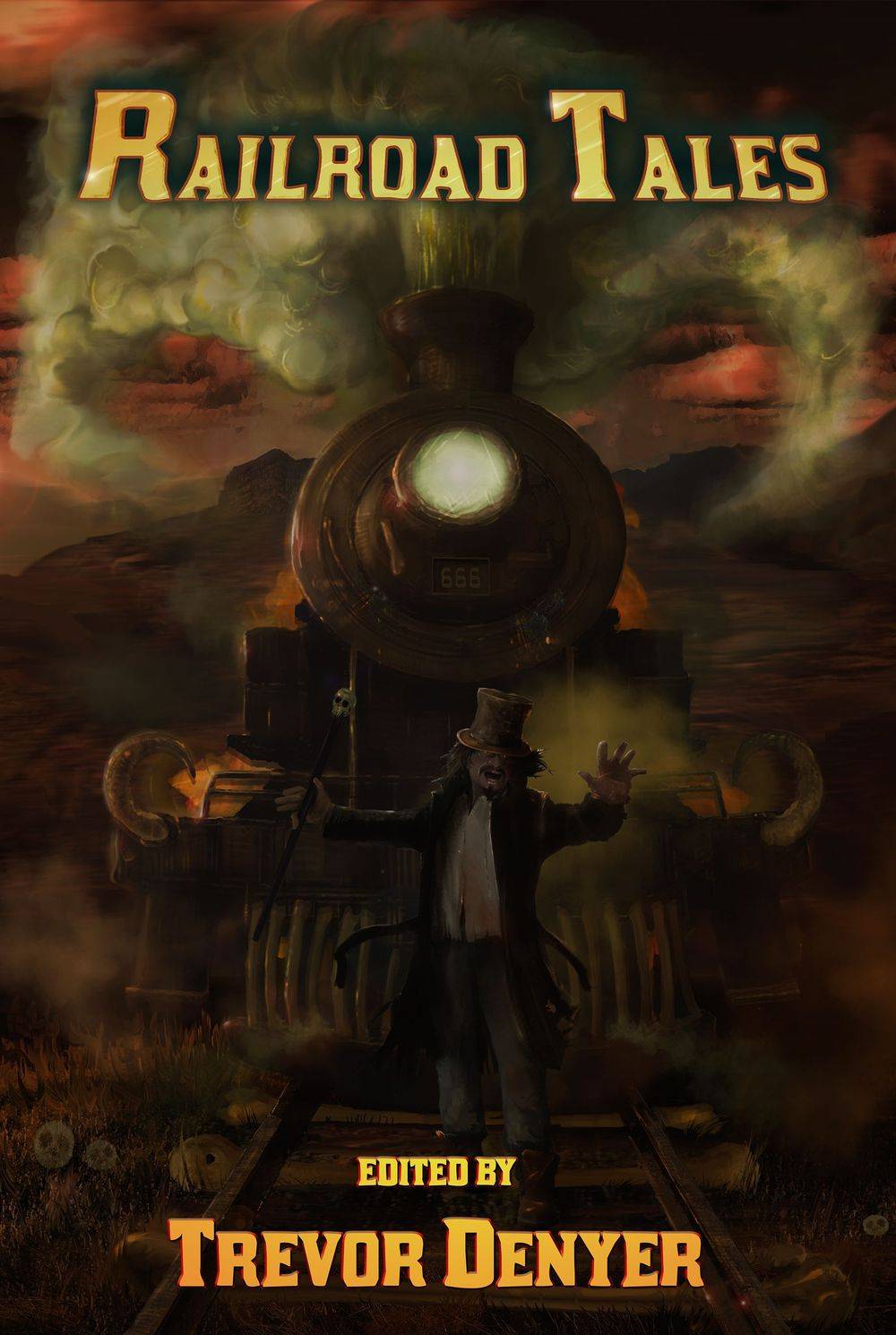
My short story titled "Caboose" has just been published in the anthology Railroad Tales, edited by Trevor Denyer, and as usual I'm writing a few words discussing how the story came to be written. There may be spoilers within.

The call for submissions for this anthology requested stories that involved the supernatural in connection with railroads, railways, or any aspect of rail travel or location. Furthermore that the stories should be set at any point in the past and be historically accurate where appropriate. I had previously written a more modern train story for a similarly-themed train anthology, "Rustblind and Silverbright", published by Eibonvale Press, but unlike that story this was more of a challenge. I don't write historical pieces. Where should I start?

I began by thinking of a recent album by The Residents, "The Ghost of Hope", which was a themed record of historical train wrecks. The Residents had been influenced by a book titled "Death by Train: Horrifying yet True Stories of Train Wrecks and Accidents 1879-1927", which I found on Kindle through Amazon. A compilation of old newspaper reports from The Bradford Era of train crashes, this was to provide excellent research. What struck me was the language used in the reports: visceral and unflinching. We think our tabloids are insensitive nowadays but nothing with this type of purple prose would pass muster today. Whilst reading I was struck by the word "Caboose", which echoed with me as a title. One article in particular stood out. Headed "A Shroud of Flame", it detailed an unfortunate incident where oil spilled onto tracks ignited, engulfing the engine and carriages and causing numerous burns and the horrific deaths of three female passengers as the unstoppable burning train tore through a snowy landscape. The piece was almost cinematic in its intensity, and I knew I wanted to write that story.

However, the train in question had no caboose! I toyed with another title, "Oil City", which was the final destination of one of the female bodies, but it didn't resonate with me. For a while I was stuck on how to proceed, until I realised that it was the very fact that there was no caboose in that train wreck that my story had to be called Caboose. This tied in directly with the haunting.

Initially my thought was to set the story historically when the incident occurred with the intention to emulate the prose of the newspaper reports, however I realised that style wasn't my style, and I needed to set the piece in the present day with reference to the past. Concerning the supernatural element, I wanted this threaded between the main story, with the perspective changing sometimes mid-sentence, as though past and present were overlayed. If ghosts exist, I see them more as appearing in parallel realms which only briefly coincide with ours, so taking one of the females from the original train crash I threaded her experience within my story.

I always write with music on a background loop and considered something from "Ghost Of Hope" (in fact, I didn't realise til afterwards that this included a song based on the same incident), but the music was narrative-heavy and I knew it would impinge on my writing. So I considered two train songs, "Long Dead Train" by Hugh Cornwell, and "Ghost Train" by The Stranglers - who Hugh was once part of, of course. Ideally - and it excited me that the songs were almost the exact same length - I wanted to play both simultaneously, to echo the supernatural past/present vibe I wanted to capture in the story, but this proved technically difficult, so I instead chose the more rhythmic "Ghost Train" which during the writing of this piece I played 84 times on repeat.


Here's an extract: She intended to keep the caboose decorated as authentically as possible to retain its character, using as much of the existing structure as she could. Whilst moving the caboose had seemed to dislodge a hundred years of dirt which had become embedded between those wooden boards and now coated the floor like ash, Molly soon swept this into a pile and then with vigorous brushstrokes jettisoned it out through the back porch where for a moment it seemed to coalesce into a definable shape before falling to the ground below.


Railroad Tales is published by Midnight Street Press and retails at £12.99 in paperback with an e-book version also available. Contributors include John Kiste, Allen Ashley, Norm Vigeant, Nidheesh Samant, James E. Coplin, Andrew Darlington, Nancy Brewka-Clark, C. M. Saunders, Saoirse Ni Chiaragáin, David Penn, Catherine Pugh, Susan York, Gayle Fidler, Gary Couzens, Caitlin Marceau, Simon Bestwick, Steven Pirie, Jim Mountfield, Andrew Hook, Michael Gore, Curtis James McConnell, George Jacobs, A. J. Lewis. Buy your copy here.

Tuesday, 3 August 2021

Mobster Thermidor

My short story titled "Mobster Thermidor" has just been published in the anthology, Crimeucopia: As In Funny Ha-Ha, Or Just Peculiar, from Murderous Ink Press, and as usual I'm writing a few words discussing how the piece came to be written. There may be spoilers within.

Over the years I've written numerous short stories and novels featuring an irascible PI named Mordent, who (although contemporary) sees the world through noir-tinted glasses and has (amongst other things) a bubblewrap fetish. I don't write a lot of crime, but I tend to default to Mordent when I do, and when the title "Mobster Thermidor" popped into my head it was a gift. Clearly a Mordent story, the play on words with lobster thermidor created a pathway for a piece which almost wrote itself.

There's not much more to be said about the gestation of this piece. Mordent gets sidetracked into a relationship with a woman with mob connections and begins the story sinking into Lake Michigan whilst wearing a concrete overcoat. As usual, conventions of noir dialogue allow an abundance of wordplay, much of it comic, hence Murderous Ink deciding to include the piece in this anthology of humorous crime stories. Mordent's way back from that restrictive garment being the thrust that propels the story.


Here's an extract: Mordent’s kind of town held a bar and a girl. He found both at the same location. Not as might be expected at The Green Mill Lounge which had been Al Capone’s favourite haunt, nor at Marge’s where bathtub gin used to be served in the cellar, nor fellow-speakeasy Twin Anchors where - renamed Tante Lee Soft Drinks during Prohibition - it sold alcohol alongside a secret basement escape hatch. Instead Mordent favoured The Red Lion Pub on North Lincoln Avenue where – in an alley across the street - gangster and bank robber Johnny Dillinger had been gunned down in 1934. Souvenir hunters had dipped newspapers and their skirts in the blood that stained the pavement. If Mordent kept his gaze askance he might almost imagine Dillinger crossing the street from the old Biograph Theater, having watched the gangster movie Manhattan Melodrama. Instead he should have kept his gaze away from Marcia, who entered stage right and sat on his left, resting her hands and then her head on the dark oak-planked bar.
“I’m beat.”
“Maybe you should be.” Mordent was a cack-hand at one-liners.

I usually listen to music when writing a short story, and in this instance I wrote whilst playing the album "Lust Lust Lust" by The Raveonettes on repeat.


Crimeucopia: As In Funny Ha-Ha Or Just Peculiar is published by Murderous Ink Press and retails at £8.99 in paperback and currently £2.49 on Kindle. Contributors include Jessie Hilson, Gabriel Stevenson, Maddi Davidson, Brandon Barrows, Robb T White, Regina Clarke, Martin Zeigler, K G Anderson, Andrew Hook, Ed Nobody, Jody Smith, Michael Grimala, W T Paterson, James Blakey, Emilian Wojnowski, Andrew Darlington, Lawrence Allan, Ricky Sprague, Bethany Maines, John M Floyd and Julie Richards. Buy your copy here.

Monday, 5 July 2021

All That Dead Beauty

 My short story titled "All That Dead Beauty" has just been published in the anthology, Shadows On The Hillside , edited by Storm Constantine, and as usual I'm writing a few words discussing how the story came to be written. There may be spoilers within.

The brief for the anthology was for explorations of the interaction between the natural landscape and mankind, on ways in which the ancient prefigures and imposes upon the modern. Quite obviously, Earth has been around far longer than we have, and has seen much that we haven't. I believe Storm was seeking stories that examined that intersection, where olden things might push at the boundaries of our existence, and exert forces quite possibly at odds with us.

I always try to seek a different angle when presented with guidelines, not simply to be obtuse (pun intended), but to switch things around a bit so that my story might be less like other contenders but also because I find that switch more interesting. So I thought, what if the outside were to come inside? What if someone wanted to slough off their rural background by living in the city, but that background followed them. What if they are spurred to remember the countryside, and cultivate it indoors. What if I pushed that to a natural - logical - conclusion?

I'd had the title "All That Dead Beauty" knocking around for some time and it seemed to fit. I had also seen the Polish film, "Spoor", which was adapted from the novel "Drive Your Plow Over The Bones Of The Dead" by Olga Tokarczuk. The film, with its agricultural landscapes, seemed to feed into the vibe of my story, and I included this as a catalyst for the main character's conversion. I had also been listening to the band, Snapped Ankles, whose music is described as channelling forests of a pagan past, and mention of them and their log synthesisers also found its way into the tale.

Having collated the stories for the anthology, Storm Constantine unfortunately passed away before publication. As the book has only just been published I've yet to read it, of course, but I feel it will be a fitting sign-off for someone to whom the natural environment and the arcane played such important roles.


Here's an extract: Waking the following morning Blake walked barefoot to the window, chippings sticking to the soles of his feet. As he watched the sunrise pick out each and every windowpane, he imagined taking the chippings and using wood glue to adhere them to his skin, covering each bare space until he became the opposite of Tetsuo, The Iron Man, until he was transformed into a creature born of forest and flesh, until buds began shooting from his fingertips, until his gait became wooden in more ways than one.

I usually listen to music when writing a short story, but in this instance I wrote whilst playing birdsong from YouTube on a loop.


Shadows On The Hillside is published by NewCon Press and retails at £12.99 in paperback and £25.99 as a limited edition hardback signed by the cover artist, Danielle Lainton. Contributors include Cat Hellisen, Andrew Hook, Sarah Singleton, Fiona McGavin, Jordan Biddulph, Nerine Dorman, Paula Wakefield, Rose Biggin, Storm Constantine, Freda Warrington, Grace Alice Evans, Emma Coleman, Kari Sperring, Wendy Darling, Jessica Gilling, Liz Williams, Paul Houghton, J. E. Bryant, John Kaiine . Buy your copy here.