I'm pleased to announce I'm going to be editing an anthology of punk-inspired stories to be published by DogHorn Publishing. Guidelines here:
For those of us of a certain generation, punk was a defining force for a DIY-attitude that revolutionized music and empowered youngsters with self-belief and a determination for change that became a major cultural UK phenomenon. Punk encapsulated youthful rebellion and embraced a variety of anti-authoritarian ideologies, and whilst musically the punk revolution took place within a very short time span, its influence continues to permeate modern day culture, from music to other art forms to an identifiable way of life.
The term ‘punk’ in fiction has been tagged in genres such as cyberpunk and steampunk, with William Gibson first coining the ‘cyberpunk’ term in an early short story. But this anthology’s focus will not be with those genres. We are looking for genuine punk: punkPunk! We are looking for punk stories that embrace the spirit of 1976 and directly reference it: the bottom line is that punk must have influenced the story itself. The genre your story is written in will be our second consideration. However, please don’t feel restricted to write about the UK summer of ’76 and nothing else. We will also consider stories inspired by the American punk scene, and are open to music influenced by the punk subgenre, including post-punk, hardcore, Oi!, anarcho-punk, and pop-punk. And we are interested in how the catalyst of punk might have influenced your characters up to the present day: how their lives have been shaped – both positively and negatively – by the music.
Finally, please be aware that song lyrics are subject to complex copyright law. If you do use song lyrics within your story then we expect you to have cleared copyright use with the original source. We will not be held responsible for any copyright infringement by an author.
FURTHER DETAILS:
1) Stories must be at least 1000 words, with a maximum of 5000 words (query for longer).
2) Stories must be submitted as a .doc file to punkpunk@doghornpublishing.com
3) Stories must be laid out in standard manuscript format – please follow the guide at http://www.shunn.net/format/story.html.
4) Violence, swearing and sexual content are acceptable, PROVIDED THEY FIT THE CONTEXT OF THE STORY. Anything gratuitous, or featured simply for shock value, will be deemed unsuitable for publication.
5) If your story also has strong SF/F/H genre elements, please be aware these will have to be used in an original way to be deemed worthy of publication. Satanic elements in rock music are best avoided.
8) Submissions will open from 1st July 2013 and will close on 31st December 2013. Stories sent after this time will not receive a reply.
9) Please note that a reply may take 4-6 weeks. If you have not heard within this time, please query.
10) Reprints will be considered – please query with the editor at punkpunk@doghornpublishing.com. Multiple submissions will not be considered – please send in your best work!
11) Accepted authors will receive two complimentary copies of the anthology. Unfortunately we are unable to pay for stories accepted.
12) Please send any additional queries to Andrew Hook at punkpunk@doghornpublishing.com
Monday, 10 June 2013

Tuesday, 4 June 2013
Bullet
As has become customary I'm making blog posts each time a story of mine gets published in order to give a little background as to how the piece came about. This time it's the turn of "Bullet", now available to read in issue #34 of the excellent Black Static magazine. Please note, this post will contain spoilers so if you have the magazine it'll be best to read this afterwards.

Very occasionally, story ideas come out of dreams. The ending to my story, "Beyond Each Blue Horizon", came at the denouement of a dream where I opened the curtains and found an entire city had been erased. Over the years, I've nicked bits and pieces of dreams for other stories, although I think it's important to ground them in reality and not simply - to paraphrase surrealist film director Luis Bunuel - to pad out the fiction. In this case, the thrust behind "Bullet" came specifically from a dream. I remember I was travelling in Thailand searching for someone I had lost. I believed I held a guidebook in my hand, but when I glanced down to see what I was holding I saw it was a copy of the novel "Bullet" by Franz Kafka.
Now, obviously, Kafka never wrote a book called "Bullet", but it crossed my mind what it might have been like if he had. That sense of altering reality that I got from the dream intrigued me, as did the search for someone. I put the idea to one side and waited for something else to happen (generally I get two ideas which mesh as one story) as it usually does.
Some time afterwards I read a news story about an island which has appeared on nautical maps for decades but which in fact doesn't exist. As part of the article it mentioned that some cartographers deliberately add false streets to maps in order to protect copyright (what a fantastic idea, that information can be falsfied by those I would have thought are sticklers for precision!). Of course, putting together the dream, the false map, Kafka's missing novel - which acts as an indication that what we are reading might not actually be true - and the missing person suddenly drew the story tight like a drawstring. I had everything I needed: location, purpose, misdirection, and my favourite device, the unreliable narrator. Just how much we shape reality from our experience is something that has always interested me, how we seize on the familiar to try and understand the unfathomable. I guess this is the heart of the story, although it is open to several readings.
The artwork accompanying the story perfectly encapsulates the piece, in my opinion. Courtesy of Richard Wagner.

Finally, the entirety of "Bullet" was written whilst listening to the album titled "Blonde" by the wonderful Coeur de Pirate on repeat. If you've read the story and enjoyed or hated it, please feel free to comment.
Monday, 20 May 2013
The Caged Sea
Once again here's a blog post about the gestation of a recently published story, this time "The Caged Sea" which appears in #4 of Unspoken Water magazine.
When writing I always need a title before I can begin a story, and in some instances the title itself is the spark for the story. In this case, the title came to me whilst at the coast (unsurprisingly I guess), whilst I was stood by some steps on the sea defences. The platform at the top of the steps implied a cage over the sea, as seen by this photograph. I made a note of the title and filed it in my memory for later.

I knew the title would act as a metaphor rather than to be used literally. After all, what can cage the sea? By it's very nature it cannot be held by bars. But as a concept I knew I could work with it. As with many of my stories I generally need three elements to converge in order to have a workable idea. One of these is always the title, and in this case I became aware of two other ideas which I knew I could work together as one. These were:
1. Everyone knows of the concept of déjà vu, but I had only recently become aware of jamais-vu. Wiki summarises it nicely: Often described as the opposite of déjà vu, jamais vu involves a sense of eeriness and the observer's impression of seeing the situation for the first time, despite rationally knowing that he or she has been in the situation before. Always obsessed with ideas of the perception of reality I knew this discovery would provide fodder for a story. I just hadn't been sure how to use it.

2. I had also been intrigued by stories of Aokigahara, a forest in Japan which is a popular place for those wishing to commit suicide. I've written several stories set in Japan, and again this concept was floating around my head waiting for something to harness it to. Doing some research on the topic I found that Aokigahara is also known as the Sea of Trees. Often in moments like this I wonder if there is an overseeing force teasing stories out of me, because "The Caged Sea" was obviously the perfect title for this story. It wasn't long before the concept of jamais-vu adhered itself and I realised I could work everything together.
Once these three elements were in place I simply added a seemingly solid yet potentially fractual relationship and the story was born. Of course, you'll have to read it to determine if you think it was effective and how it all came together. Unspoken Water #4 also contains stories and poetry by Mike Chinn, Marion Pitman, Lee Clark Zumpe, Derek Muk, Rebekah Memel Brown, Brian M. Milton, Richard King Perkins ll and Stephen Palmer.
Thursday, 16 May 2013
Always Different, Always The Same
I don't normally blog gig reviews, mostly because I find I have little to say. Nowadays I tend to have the time/money only to see bands I know I'm going to like, so gig reviews would probably be restricted to effusive gushings that only diehards would be interested in reading. But then, of course, there will always be exceptions. And the exception here are The Fall.
I've seen them around half a dozen times since the mid-eighties. Most of their gigs begin with myself wondering why I've turned up, then suddenly something twists and I'm caught in a primal whirligig of relentless repetition, the music building on itself layer after layer, with Mark E Smith's barely discernible vocals/rant surfing the sounds whilst he himself resembles a dementia patient wandering around disorientated after escaping from a nursing home. Last night at The Waterfront in Norwich was one such gig.
But it wasn't just The Fall. Opening act Dingus Khan are an 8-piece band with three drummers and three bassists, an astonishingly happy frontman wearing your gran's calf-length purple nightdress, and an impressive set of tunes bordering on madness interspersed with whistling and extremely silly dances. Everything that's wrong with modern day pre-packaged music isn't wrong with Dingus Khan. Their jubilence was catching and I loved them.

Unfortunately there was also a second support act, There's Someone In The Pond. Bassist, guitarist, female drummer (resembling Noel Fielding); all the components were there for a top act, but when the first song started and I thought 'this sounds familiar' it quickly became apparent that all their songs sounded familiar because they had ripped off every riff you could think of and done nothing original with it. Their music was bland and I hated them.
And then we have The Fall. Keyboardist Elena Poulou arrives on stage, takes off her coat and lays it over some luggage she places on a chair beside her Korg. The other band members start playing, and shortly afterwards Smith stumbles and mumbles onto the stage, walking aimlessly fiddling with microphones and amplifiers, stands with his back to the audience, gives an occasional - piercing - direct look, sits at the back of the stage, and oversees proceedings like the bandleader he is. The music grows and is intense. Culled mostly from new album, "Re-Mit", the surprise of "Theme From Sparta FC" is welcomed heartily, and "Bury" from "Your Future Our Clutter" also rocks as does "I've Been Duped" from "Imperial Wax Solvent". Before the end of the set - who knows - Smith walks off, and after several long minutes the band return without him, Poulou mentioning something about him not wanting to work with those microphones.

What follows is structured anarchy. The band launch into "Reformation!" with the microphones handed out to members of Dingus Khan who have been in the audience for the gig. They enthusiastically shout "Reformation!" at the required intervals whilst the band ploughs on. Then they stage invade, Poulou leaves, security arrives, and a struggle ensues as they are wrestled to the ground against the beating drum bass guitar soundtrack. One is ejected but not before handing the microphone to another audience member. It wasn't beyond the realms of possibility that the microphone baton could be taken up by everyone in the audience until each were forced to leave the building leaving the band continuing "Reformation!" until the end before an empty auditorium. In any event, the song must have been extended by a good five minutes.
This is what gigs are supposed to be like. It crossed my mind that The Fall would have been buzzed off within ten seconds by the general public and their hideous facades on something like Britain's Got Talent. But Britain does have talent. And that talent is lead by Mark E Smith of The Fall.

So this is why I don't blog gig reviews because it's turned out to be sycophantically effusive anyway and still hasn't managed to capture the joy of being there. Oh well, as a counterbalance I should mention my tinnitus seems to have worsened. That's the pay off. And I had earplugs in too.
Thursday, 9 May 2013
Three Wishes
We've all wondered what we might do if we had three wishes. For those amongst us who are sensible, the first wish must be to have an unlimited supply of wishes. Or maybe that should be the third wish, in order to gain an unlimited supply plus those first two wishes. Immortality would also be useful, although it's essential to be careful and specific as to how you wish for it - it would probably be best to throw in a preferred age and status of health with some 'not getting older' stuff into the mix. And we've all read books or seen movies where those granted wishes inadvertently use the term "I wish..." without actually thinking they're making a wish. The whole business is a bit fraught, which is why author Emma Newman's idea of making wishes come true seems down to earth and quite possibly achievable.
You'll have to read the exact guidelines on her Split Worlds website to see why the wishes I've chosen don't include immortality, great wealth, or a everlasting parade of long-snouted animals, but for the moment here are my three wishes:
1. my partner's put a lot of work into editing Fur-Lined Ghettos magazine. We'd like to sell more copies!
2. my novella, "And God Created Zombies", published in 2009 by NewCon Press was at one point being considered for adaptation as a graphic novel. That fell through. I'm hoping there might be someone out there to take it up again
3. I once sent a copy of my comic novella, "Ponthe Oldenguine", to Noel Fielding from The Mighty Boosh suggesting he make it into a movie. It would be nice to receive a reply
So, there we have it. Make my wishes come true!
And here's the housekeeping bit:
"These three wishes are part of a wish-making community organised by author Emma Newman to celebrate the release of the second Split Worlds novel "Any Other Name". Can you make any of them come true? Come and see what other people are wishing for and find out how to join in at www.splitworlds.com/split-worlds-extra/three-wishes – who knows, perhaps someone could make one of your wishes come true."
Check out Emma's novels as well, if you are intrigued by the idea of Downton Abbey crossed with the Fae.
Wednesday, 1 May 2013
Proboscis Monkey
It's been a while since I made a post about my favourite kind of animal - those with particularly elongated snouts - so what better way to celebrate the 1st May than by showcasing an animal whose very name is derived from a word for snout?
Of course, it has to be the proboscis monkey:

I remember my first encounter with the probsocis monkey as a stuffed animal in the natural history collection at Norwich Castle Museum. This exhibit might even have initiated my love for long-snouted animals - who could fail to be enchanted by such a being.
From wiki: "The proboscis monkey (Nasalis larvatus) or long-nosed monkey, known as the bekantan in Malay, is a reddish-brown arboreal Old World monkey that is endemic to the south-east Asian island of Borneo. The monkey also goes by the Malay name monyet belanda ("Dutch monkey"), or even orang belanda ("Dutchman"), as Indonesians remarked that the Dutch colonisers often had similarly large bellies and noses."

I love that wiki also goes on to explain: "This species of monkey is easily identifiable because of its unusually large nose." Although I do prefer the word snout.
Ladies and Gentlemen, I give you the proboscis monkey:

Of course, it has to be the proboscis monkey:
I remember my first encounter with the probsocis monkey as a stuffed animal in the natural history collection at Norwich Castle Museum. This exhibit might even have initiated my love for long-snouted animals - who could fail to be enchanted by such a being.
From wiki: "The proboscis monkey (Nasalis larvatus) or long-nosed monkey, known as the bekantan in Malay, is a reddish-brown arboreal Old World monkey that is endemic to the south-east Asian island of Borneo. The monkey also goes by the Malay name monyet belanda ("Dutch monkey"), or even orang belanda ("Dutchman"), as Indonesians remarked that the Dutch colonisers often had similarly large bellies and noses."

Ladies and Gentlemen, I give you the proboscis monkey:

Just gasp at the size of that snout!
Monday, 22 April 2013
Irrealism Is Deafening
Labels can be useful tools. Certain consumers like them because they need to be told what it is they should be buying, just in case they end up with something different. Certain consumers have a fear of buying something different, particularly if that something might be other than mainstream. Other consumers are more eclectic, but even those who like art that might be considered 'underground' still have very definite parameters for what it is they should be buying. Our consumer culture is restricted by compartmentalisation, and if - like me - you tend to work in the underground that's beneath the underground, then actually selling product to the right people can be quite difficult. Particularly when they don't know what they're looking for.

As a writer, most of my short stories fall into 'slipstream'. I didn't set out to write slipstream. I simply wrote, and it turned out later that around the same time I started to write there were quite a few writers writing similar stories which they were classing as slipstream. This is an important point. I didn't set out to write slipstream or become defined by it - it just happened to be similar to what I was already writing. And because it's such a catch-all definition, I'm happy to call myself a slipstream writer for those readers who are underground the underground and who might just pick up a book of mine because of it.
This brings us onto Irrealism. When my partner, Sophie, wanted to start a magazine she knew what kind of material she didn't want, but it was harder to define what she did want. Some writers need to be told what to write in order that they can submit something to a magazine, and not having a definite guideline makes it hard for them. I'm sure she would prefer writers who didn't try and write for the magazine, but those who might write something and then find the magazine and realise that it was perfect for them, but in any event she attempted to define some guidelines and found a certain percent of writers understood them and others didn't (and several who wouldn't have done, however specific they might have been, because they don't really read them).
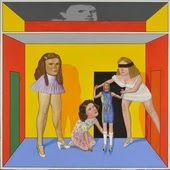
She's good with words, in my opinion. With a view to promoting Fur-Lined Ghettos at an event in Norwich recently she came up with the phrase: "irreality is deafening".
Now, as it turns out, whilst she had no idea what irrealism might be - or even that it actually existed because she had plucked the word from the air - there was suddenly a 'slipstream' moment when she googled the term and realised it was exactly the kind of thing she was looking to publish in the magazine.

From wiki: 'an estrangement from our generally accepted sense of reality' and also forms of writing which can only 'offer particular versions of reality rather than actual descriptions of it'. My understanding of this tends to be a little nebulous. But in art, for example, I would suggest that a painting of a house isn't actually a house. Just as a description of a house isn't a house. This difference, to me, represents irreality. This dichotomy between what is and what isn't tends to be what she is looking to put in the magazine. Wiki suggests this includes writers such as Kafka, Borges and Donald Barthelme, and painters such as Rene Magritte. Again, these authors might well have written material which she would have taken for Fur-Lined Ghettos. Assuming they read our submission guidelines.
But not exclusively of course. Because whilst Fur-Lined Ghettos might now embrace irrealism, it doesn't seek to be defined by it.

For the moment, however, irrealism is our new catchword. Buy a copy of Fur-Lined Ghettos or submit a piece of writing to us, now that you - as a consumer - know what it is she is publishing.
Incidentally, I have peppered this blog post with images found by putting 'irrealism' in a google image search. No admissions are made as to their validity.

As a writer, most of my short stories fall into 'slipstream'. I didn't set out to write slipstream. I simply wrote, and it turned out later that around the same time I started to write there were quite a few writers writing similar stories which they were classing as slipstream. This is an important point. I didn't set out to write slipstream or become defined by it - it just happened to be similar to what I was already writing. And because it's such a catch-all definition, I'm happy to call myself a slipstream writer for those readers who are underground the underground and who might just pick up a book of mine because of it.
This brings us onto Irrealism. When my partner, Sophie, wanted to start a magazine she knew what kind of material she didn't want, but it was harder to define what she did want. Some writers need to be told what to write in order that they can submit something to a magazine, and not having a definite guideline makes it hard for them. I'm sure she would prefer writers who didn't try and write for the magazine, but those who might write something and then find the magazine and realise that it was perfect for them, but in any event she attempted to define some guidelines and found a certain percent of writers understood them and others didn't (and several who wouldn't have done, however specific they might have been, because they don't really read them).
She's good with words, in my opinion. With a view to promoting Fur-Lined Ghettos at an event in Norwich recently she came up with the phrase: "irreality is deafening".
Now, as it turns out, whilst she had no idea what irrealism might be - or even that it actually existed because she had plucked the word from the air - there was suddenly a 'slipstream' moment when she googled the term and realised it was exactly the kind of thing she was looking to publish in the magazine.

From wiki: 'an estrangement from our generally accepted sense of reality' and also forms of writing which can only 'offer particular versions of reality rather than actual descriptions of it'. My understanding of this tends to be a little nebulous. But in art, for example, I would suggest that a painting of a house isn't actually a house. Just as a description of a house isn't a house. This difference, to me, represents irreality. This dichotomy between what is and what isn't tends to be what she is looking to put in the magazine. Wiki suggests this includes writers such as Kafka, Borges and Donald Barthelme, and painters such as Rene Magritte. Again, these authors might well have written material which she would have taken for Fur-Lined Ghettos. Assuming they read our submission guidelines.
But not exclusively of course. Because whilst Fur-Lined Ghettos might now embrace irrealism, it doesn't seek to be defined by it.

For the moment, however, irrealism is our new catchword. Buy a copy of Fur-Lined Ghettos or submit a piece of writing to us, now that you - as a consumer - know what it is she is publishing.
Incidentally, I have peppered this blog post with images found by putting 'irrealism' in a google image search. No admissions are made as to their validity.

Subscribe to:
Posts (Atom)