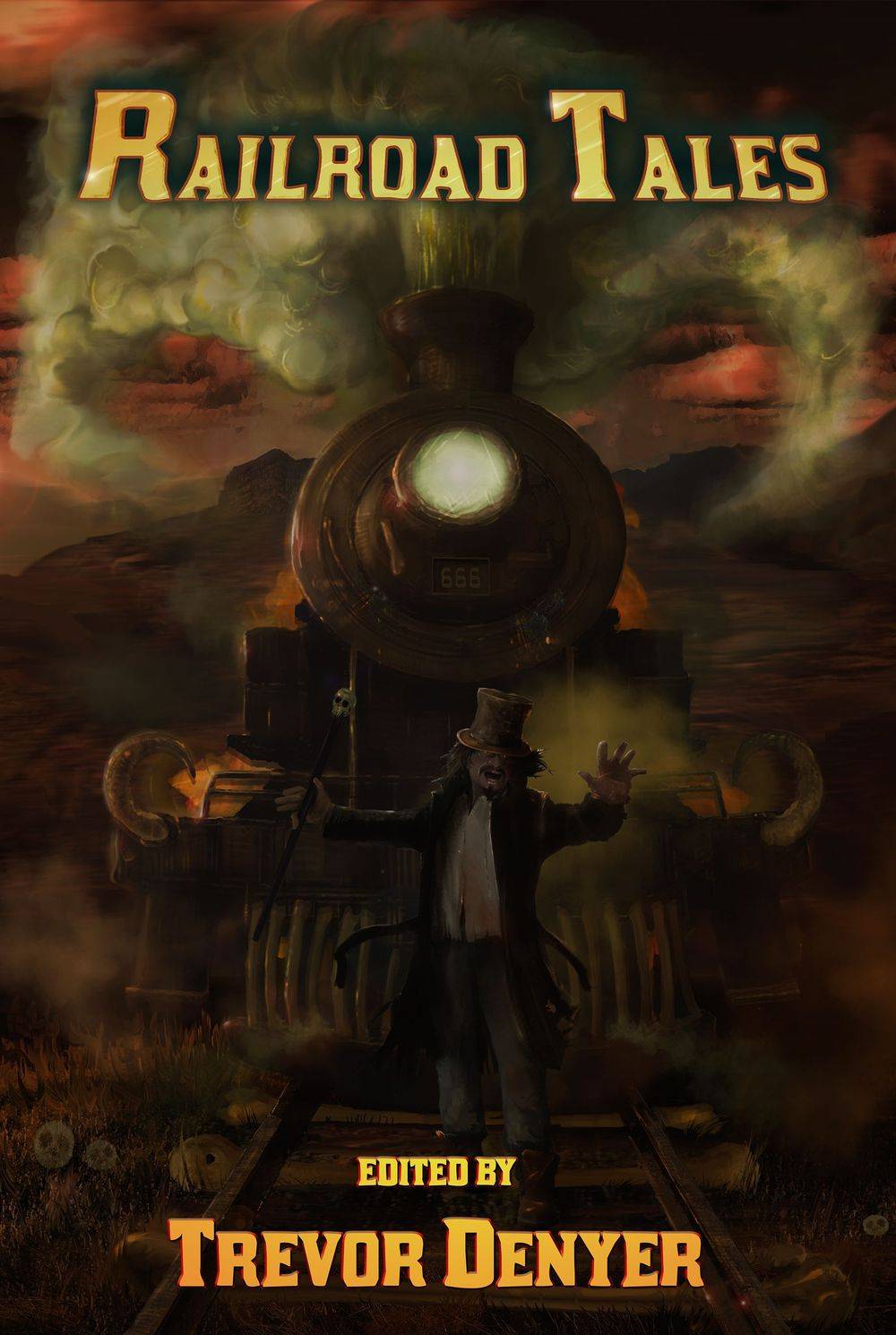
My short story titled "Caboose" has just been published in the anthology Railroad Tales, edited by Trevor Denyer, and as usual I'm writing a few words discussing how the story came to be written. There may be spoilers within.
The call for submissions for this anthology requested stories that involved the supernatural in connection with railroads, railways, or any aspect of rail travel or location. Furthermore that the stories should be set at any point in the past and be historically accurate where appropriate. I had previously written a more modern train story for a similarly-themed train anthology, "Rustblind and Silverbright", published by Eibonvale Press, but unlike that story this was more of a challenge. I don't write historical pieces. Where should I start?
I began by thinking of a recent album by The Residents, "The Ghost of Hope", which was a themed record of historical train wrecks. The Residents had been influenced by a book titled "Death by Train: Horrifying yet True Stories of Train Wrecks and Accidents 1879-1927", which I found on Kindle through Amazon. A compilation of old newspaper reports from The Bradford Era of train crashes, this was to provide excellent research. What struck me was the language used in the reports: visceral and unflinching. We think our tabloids are insensitive nowadays but nothing with this type of purple prose would pass muster today. Whilst reading I was struck by the word "Caboose", which echoed with me as a title. One article in particular stood out. Headed "A Shroud of Flame", it detailed an unfortunate incident where oil spilled onto tracks ignited, engulfing the engine and carriages and causing numerous burns and the horrific deaths of three female passengers as the unstoppable burning train tore through a snowy landscape. The piece was almost cinematic in its intensity, and I knew I wanted to write that story.
However, the train in question had no caboose! I toyed with another title, "Oil City", which was the final destination of one of the female bodies, but it didn't resonate with me. For a while I was stuck on how to proceed, until I realised that it was the very fact that there was no caboose in that train wreck that my story had to be called Caboose. This tied in directly with the haunting.
Initially my thought was to set the story historically when the incident occurred with the intention to emulate the prose of the newspaper reports, however I realised that style wasn't my style, and I needed to set the piece in the present day with reference to the past. Concerning the supernatural element, I wanted this threaded between the main story, with the perspective changing sometimes mid-sentence, as though past and present were overlayed. If ghosts exist, I see them more as appearing in parallel realms which only briefly coincide with ours, so taking one of the females from the original train crash I threaded her experience within my story.
I always write with music on a background loop and considered something from "Ghost Of Hope" (in fact, I didn't realise til afterwards that this included a song based on the same incident), but the music was narrative-heavy and I knew it would impinge on my writing. So I considered two train songs, "Long Dead Train" by Hugh Cornwell, and "Ghost Train" by The Stranglers - who Hugh was once part of, of course. Ideally - and it excited me that the songs were almost the exact same length - I wanted to play both simultaneously, to echo the supernatural past/present vibe I wanted to capture in the story, but this proved technically difficult, so I instead chose the more rhythmic "Ghost Train" which during the writing of this piece I played 84 times on repeat.
Here's an extract: She intended to keep the caboose decorated as authentically as possible to retain its character, using as much of the existing structure as she could. Whilst moving the caboose had seemed to dislodge a hundred years of dirt which had become embedded between those wooden boards and now coated the floor like ash, Molly soon swept this into a pile and then with vigorous brushstrokes jettisoned it out through the back porch where for a moment it seemed to coalesce into a definable shape before falling to the ground below.
Railroad Tales is published by Midnight Street Press and retails at £12.99 in paperback with an e-book version also available. Contributors include John Kiste, Allen Ashley, Norm Vigeant, Nidheesh Samant, James E. Coplin, Andrew Darlington, Nancy Brewka-Clark, C. M. Saunders, Saoirse Ni Chiaragáin, David Penn, Catherine Pugh, Susan York, Gayle Fidler, Gary Couzens, Caitlin Marceau, Simon Bestwick, Steven Pirie, Jim Mountfield, Andrew Hook, Michael Gore, Curtis James McConnell, George Jacobs, A. J. Lewis. Buy your copy here.
My short story titled "Mobster Thermidor" has just been published in the anthology, Crimeucopia: As In Funny Ha-Ha, Or Just Peculiar, from Murderous Ink Press, and as usual I'm writing a few words discussing how the piece came to be written. There may be spoilers within.
Over the years I've written numerous short stories and novels featuring an irascible PI named Mordent, who (although contemporary) sees the world through noir-tinted glasses and has (amongst other things) a bubblewrap fetish. I don't write a lot of crime, but I tend to default to Mordent when I do, and when the title "Mobster Thermidor" popped into my head it was a gift. Clearly a Mordent story, the play on words with lobster thermidor created a pathway for a piece which almost wrote itself.
There's not much more to be said about the gestation of this piece. Mordent gets sidetracked into a relationship with a woman with mob connections and begins the story sinking into Lake Michigan whilst wearing a concrete overcoat. As usual, conventions of noir dialogue allow an abundance of wordplay, much of it comic, hence Murderous Ink deciding to include the piece in this anthology of humorous crime stories. Mordent's way back from that restrictive garment being the thrust that propels the story.
Here's an extract: Mordent’s kind of town held a bar and a girl. He found both at the same location. Not as might be expected at The Green Mill Lounge which had been Al Capone’s favourite haunt, nor at Marge’s where bathtub gin used to be served in the cellar, nor fellow-speakeasy Twin Anchors where - renamed Tante Lee Soft Drinks during Prohibition - it sold alcohol alongside a secret basement escape hatch. Instead Mordent favoured The Red Lion Pub on North Lincoln Avenue where – in an alley across the street - gangster and bank robber Johnny Dillinger had been gunned down in 1934. Souvenir hunters had dipped newspapers and their skirts in the blood that stained the pavement. If Mordent kept his gaze askance he might almost imagine Dillinger crossing the street from the old Biograph Theater, having watched the gangster movie Manhattan Melodrama. Instead he should have kept his gaze away from Marcia, who entered stage right and sat on his left, resting her hands and then her head on the dark oak-planked bar.
“I’m beat.”
“Maybe you should be.” Mordent was a cack-hand at one-liners.
I usually listen to music when writing a short story, and in this instance I wrote whilst playing the album "Lust Lust Lust" by The Raveonettes on repeat.
Crimeucopia: As In Funny Ha-Ha Or Just Peculiar is published by Murderous Ink Press and retails at £8.99 in paperback and currently £2.49 on Kindle. Contributors include Jessie Hilson, Gabriel Stevenson, Maddi Davidson, Brandon Barrows, Robb T White, Regina Clarke, Martin Zeigler, K G Anderson, Andrew Hook, Ed Nobody, Jody Smith, Michael Grimala, W T Paterson, James Blakey, Emilian Wojnowski, Andrew Darlington, Lawrence Allan, Ricky Sprague, Bethany Maines, John M Floyd and Julie Richards. Buy your copy here.
My short story titled "All That Dead Beauty" has just been published in the anthology, Shadows On The Hillside , edited by Storm Constantine, and as usual I'm writing a few words discussing how the story came to be written. There may be spoilers within.
The brief for the anthology was for explorations of the interaction between the natural landscape and mankind, on ways in which the ancient prefigures and imposes upon the modern. Quite obviously, Earth has been around far longer than we have, and has seen much that we haven't. I believe Storm was seeking stories that examined that intersection, where olden things might push at the boundaries of our existence, and exert forces quite possibly at odds with us.
I always try to seek a different angle when presented with guidelines, not simply to be obtuse (pun intended), but to switch things around a bit so that my story might be less like other contenders but also because I find that switch more interesting. So I thought, what if the outside were to come inside? What if someone wanted to slough off their rural background by living in the city, but that background followed them. What if they are spurred to remember the countryside, and cultivate it indoors. What if I pushed that to a natural - logical - conclusion?
I'd had the title "All That Dead Beauty" knocking around for some time and it seemed to fit. I had also seen the Polish film, "Spoor", which was adapted from the novel "Drive Your Plow Over The Bones Of The Dead" by Olga Tokarczuk. The film, with its agricultural landscapes, seemed to feed into the vibe of my story, and I included this as a catalyst for the main character's conversion. I had also been listening to the band, Snapped Ankles, whose music is described as channelling forests of a pagan past, and mention of them and their log synthesisers also found its way into the tale.
Having collated the stories for the anthology, Storm Constantine unfortunately passed away before publication. As the book has only just been published I've yet to read it, of course, but I feel it will be a fitting sign-off for someone to whom the natural environment and the arcane played such important roles.
Here's an extract: Waking the following morning Blake walked barefoot to the window, chippings sticking to the soles of his feet. As he watched the sunrise pick out each and every windowpane, he imagined taking the chippings and using wood glue to adhere them to his skin, covering each bare space until he became the opposite of Tetsuo, The Iron Man, until he was transformed into a creature born of forest and flesh, until buds began shooting from his fingertips, until his gait became wooden in more ways than one.
I usually listen to music when writing a short story, but in this instance I wrote whilst playing birdsong from YouTube on a loop.
Shadows On The Hillside is published by NewCon Press and retails at £12.99 in paperback and £25.99 as a limited edition hardback signed by the cover artist, Danielle Lainton. Contributors include Cat Hellisen, Andrew Hook, Sarah Singleton, Fiona McGavin, Jordan Biddulph, Nerine Dorman, Paula Wakefield, Rose Biggin, Storm Constantine, Freda Warrington, Grace Alice Evans, Emma Coleman, Kari Sperring, Wendy Darling, Jessica Gilling, Liz Williams, Paul Houghton, J. E. Bryant, John Kaiine . Buy your copy here.
Well, it's that time of the year when everyone is doing their 'best and worst of' lists, so here is mine. I'm going to list the books and movies and records I read/watched/listened to in 2020 and then pick my favourites. This isn't restricted to what was new in 2020, but what I actually watched and read and heard - some of these items might be very old indeed.
Books:
I read the following in 2020:
Rachel Smith – Artificial Flowers
Allen Ashley & Sarah Doyle (editors) - Humanagerie
Philip Roth – The Dying Animal
Mark Morris (editor) – New Fears 2
Exquisite Corpse – Poppy Z Brite
Deborah Harry / Marcus Reichert / Amos Chan – Behind Union City
Jorge Luis Borges – Doctor Brodie’s Report
James Everington & Dan Howarth (editors) – Imposter Syndrome
Philip K Dick – A Maze Of Death
Nina Allan – The Rift
Brian Aldiss – Frankenstein Unbound
Cathay Che – Platinum Blonde
Georges Simenon – The Snow Was Dirty
Juan Rulfo – Ilano In Flames
Ian Whates (editor) – Ten Tall Tales
Andrew Humphrey – Trick Of The Light
Malcolm Devlin – Engines Beneath Us
The Arrival of Missives – Aliya Whiteley
Don Delillo – The Names
Javier Marias – All Souls
Mark West and Stephen Bacon – The Lost Film
Jeffrey Eugenides – The Virgin Suicides
Jonathan Carroll – Bones of the Moon
Andrew Gallix, Tomoé Hill & C.D. Rose (editors) – Love Bites
John Travis – The Terror and the Tortoiseshell
Georges Perec – W, or The Memory of Childhood
George Sandison (editor) – 2084
Giorgio de Chirico – Hebdomeros
Breece D’J Pancake – Trilobites
Ian McEwan – On Chesil Beach
Allen Ashley – The Planet Suite
C S Forester – Payment Deferred
Ian Drew Forsyth (editor) – Afterlives Of The Writers
Brian Aldiss – Non-Stop
Georgina Bruce - Honeybones
Ross Warren Anthony Watson (editors) – Darker Minds
Arthur Schnitzler – Dream Story
Marcus Reichert – The Memoirs of Jerome Berger
Pascal Garnier – Moon In A Dead Eye
James Everington – The Quarantined City
The Residents – The Brickeaters
Eugen Bacon – The Road To Woop Woop
Douglas Thompson – Barking Circus
Eugen Bacon – Ivory’s Story
Haruki Murakami – Colorless Tsukuru Tazaki and His Years of Pilgrimage
Joel Lane – The Autumn Myth
Quentin S Crisp – Remember You’re A One-Ball
Brian Clemens – Rabbit Pie
Caroline Hardaker – Composite Creatures
Debbie Harry – Face It
Celeste Bell & Zoe Howe – Dayglo: The Poly Styrene Story
That's worked out at 51 books this year, up ten from last years 41 so pretty good, and much helped by Covid-19 which meant I was reading a lot more in the day job for a month or two. My target is generally 50 books a year, so I'm happy with this. I should mention that I also proofread and copyedit and adding those novels into the mix would increase the list by about 25 books this year.
I can count the number of books I've ever given up on before finishing them on one hand, and unfortunately this year that includes "Ilano In Flames", a collection of short stories by Juan Rulfo which I just couldn't get into. Other books I weren't keen on included "On Chesil Beach" by Ian McEwan (so appalling British, so righteously sneering, so dumbingly anal), "Honeybones" by Georgina Bruce (which I desperately wanted to connect with, but just couldn't - try it though, others love it), "Moon In A Dead Eye" by Pascal Garnier (one-dimensional, run-of-the-mill), "Remember You're A One-Ball" by Quentin S Crisp (which I found passionless and unengaging), and "Rabbit Pie", a collection of short stories by Brian Clemens which was ok but which has dated considerably from when it was written.
I made an effort again this year to read more books by authors that I know personally and out of the 51 books this included 22 from such folk (including a few books read for review and those in an editorial role). Overall, the following deserve special mentions across the board: "Humanagerie" edited by Allen Ashley and Sarah Doyle (an animal-themed anthology of poetry and prose), "The Dying Animal" by Philip Roth (typical white middle-class male perspective, but bang on the nose with it), "New Fears 2" edited by Mark Morris (some brilliant horror stories here), "Exquisite Corpse" by Poppy Z Brite (exquisite!), "Doctor Brodie's Report" by Jorge Luis Borges (a strong collection of his later short stories which are primarily realistic in nature, although in some instances proving realism is equal to the fantastical), Nina Allen's "The Rift" (a writer who also mixes the mundane with the fantastical in this great novel), "Engine Beneath Us" by Malcolm Devlin (great novella with some interesting ideas), and another novella, "The Arrival of Missives", by Aliya Whiteley. I'd also recommend "Terror and the Tortoiseshell" by John Travis (noir detective story, with animals), "The Planet Suite" by Allen Ashley (the expanded version of his earlier novel of the same title: inventive and brilliantly written), "W, Or The Memory Of Childhood" by Georges Perec (a powerful treatise on both memory and remembrance), "Hebdomeros" by Giorgio de Chirico (one of the most immediately engaging surrealist books that I've read), "The Memoirs of Jerome Berger" by Marcus Reichert (an existential jailbreak novel with a dash of authentic narrative surrealism), "The Quarantined City" by James Everington (almost made my top three, brilliant central conceit), Douglas Thompson's endlessly inventive "Barking Circus", Eugen Bacon's vibrant "Ivory's Story" (and her collection, "The Road To Woop Woop"), and finally Deborah Harry's autobiography, "Face It".
However, as usual, I'm going to base my top three from my Goodreads reviews. Four books received my 5/5 rating, and so I'm edging out "Behind Union City: The Making of an Independent Film" by Amos Chan, Deborah Harry and Marcus Reichert, which is a sumptuously beautiful book about the film Union City containing both stills and original photographs, as I tend to stick to fiction in these round-ups. However, without further ado, here are my favourite reads of 2020:
In reverse order:
"The Bones of the Moon" by Jonathan Carroll
A beautiful couple meet, fall in love, and have the world at their feet, but the world has other plans and conspires to undo them by renting reality asunder. In this case, the cause could be the guilt Cullen James feels over an earlier abortion, but pinning psychological meaning under character's actions aren't really necessary in Carroll's work because it is the journey which needs to be savoured and not the vehicle you travel in. A good Carroll novel makes you want to be part of that world - however romantic or terrifying it may be. "Bones of the Moon" ticks those boxes for me and whilst often I feel Carroll really doesn't know how to end his books (they can feel abrupt, or unsatisfactory, or insufficient), here everything pulls together well.
"The Names" by Don DeLillo
The back cover blurb describes this as an 'exotic thriller' and it would be interesting to know what usual readers of 'exotic thrillers' would think of this novel because it certainly - thankfully - isn't that. What we have here are deliberations on language, culture, identity, relationships, isolation and good old white middle-aged male angst and existentialism. Everything is exquisitely rendered with some of the best prose I've encountered for a long while. The pacing is slow, a little scattershot, but somehow works. The 'thriller' aspect is glacial, muted, incidental. I love books which run around the outside of things without needing to speak specifics and I loved this.
And the winner is:
"Colorless Tsukuru Tazaki and His Years of Pilgrimage" by Haruki Murakami
I won't lie that this took me a while to get into - the set-up seemed too pat to be convincing - but where Murakami works best for me is when he pinpoints and nudges that tiny ache inside you, that difference between wanting to be like everyone else and wanting to be different. It's not necessarily so overt in his other novels, but they do have that sense of be(longing); here, it's more explicit, and it resonated deeply. Murakami walks a line of everything being preordained despite us having free will, he sees past present and future for what they are - a jagged edge rather than a linear construct. Without giving spoilers away, the last chapter encapsulated that for me (others might prefer a different resolution), whilst retaining that sense of mystery, whilst defining that ache that just can't be erased, whilst understanding that the reader knows this, whilst wanting that ache to remain. For that reason alone, it has to be my number one for this year.
Movies:
I watched the following in 2020:
Jessica Forever
Here To Be Heard: The Story of the Slits
Paterson
Thirst
Phantom Thread
In Fabric
GUO4
Une Femme Est Une Femme
Solaris
Custody
The Castle
You Were Never Really Here
Alphaville
River of Grass
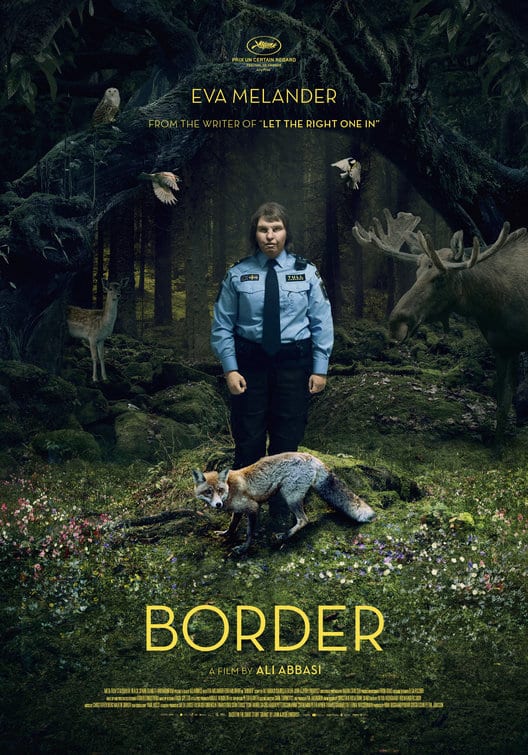
Border
The Favourite
Miss Americana
High Life
Midsommar
Bob le Flambeur
George Washington
Lady Bird
The Idiots
Fantastic Planet
The Wild Goose Lake
The Man From London
Les Valseuses
Robot Monster
Night Train
Valley of Love
Sympathy For Mr Vengeance
Un Flic
Sharknado
The Cabinet of Dr Caligari
Querelle
Cemetery of Splendour
47 Meters Down: Uncaged
Bad Taste
Hiroshima Mon Amour
Celine and Julie Go Boating
The Consequences of Love
Il Divo
One Man Up
The Family Friend
Endless Poetry
The Blood of a Poet
Testament of Orpheus
Primer
No End
Time Trap
Visitor Q
Le Corbeau
La Bête Humaine
John Wick
Toy Story
Animal Crackers
Everest: Death Zone
Popeye The Sailor vs Sinbad The Sailor
Piglet’s Big Movie
Redoubtable
A Bug’s Life
Cars
Coffy
Swimming Pool
Angel Face
The Shining
The Addams Family (2019)
Colossal
The SpongeBob Movie: Sponge Out of Water
Minions
The Devil All The Time
The Trout
Willy Wonka and the Chocolate Factory
Baxter, Vera Baxter
What Have They Done To Your Daughters?
Alvin & The Chipmunks: Chipwrecked
See No Evil, Hear No Evil
Hotel Transylvania
Stir Crazy
The Lorax
Onward
Theatre of Blood
Seberg
Once Upon A Time…In Hollywood
Parasite
The Great Alligator
Creep
Cure
Monster House
The SpongeBob Movie: Sponge On The Run
Things To Come
The Other Lamb
Meek’s Cutoff
His House
My Favourite Wife
Rio
Jojo Rabbit
Rio 2
Calibre
Malina
The Grinch
Sorry To Bother You
Alien
The Hills Have Eyes
Lilo & Stitch
Folklore: The Long Pond Studio Sessions
The Platform
8 Women
The Christmas Chronicles
The Kindergarten Teacher
The Muppet Christmas Carol
Swallow
Elf
They Listen
Abominable
Black Water: Abyss
Cold Meridian
Where The Wild Things Are
A Short Film About Love
A Short Film About Killing
That's 120 movies this year, a staggering 49 up from last year which is just what I wanted! Mostly this is due to my partner's working hours realigning with mine, renting about 25 movies from our library during the first Covid-19 lockdown, buying a larger TV to make the experience more enjoyable, but also making time each Friday to watch kid-friendly movies with my eight year old. From those, "Onward" won our hearts this year. All of us were crying.
Anyway, this means it's quite a long list to narrow down to my top three, and unlike books I don't have a site equivalent to Goodreads with which to guide my memory.
As usual, however, I'm discounting movies I've previously seen. So this knocks out one of my favourite films, Jean-Luc Godard's "Une Femme Est Une Femme" which I've seen half a dozen times or more, "Alphaville", also by Godard, which was much better third time around, Peter Jackson's "Bad Taste" (clearly his best movie), the sublime "Willy Wonka and the Chocolate Factory" (which I could watch on repeat and cry every time, Gene Wilder and the whole cast are brilliant), and films as diverse as "Animal Crackers" and "The Shining". Not to forget either the final two films on the list by Krzysztof Kieślowski which are sublime.
Those movies which I found annoying or awful are easy to chronicle, and this includes "In Fabric" (I've loved Peter Strickland's other films, but I almost physically and mentally recoiled from this it was so bad), "High Life" (director Claire Denis and actress Juliette Binoche should have been a match made in heaven, but I just couldn't engage with this film), "Sharknado" (which is so obviously awful, but I still had a lot of fun with), "Parasite" (the Oscar-winning South Korean film which I thought opened with some good ideas but which finished up all over the shop), and "Jojo Rabbit" which I really wanted to enjoy but which I found vacuous and derivative.
One of my favourite platforms for movies is Mubi, and I loved that they showed a variety of Isabelle Huppert movies this year, as I would rate her as my favourite actress. These included "The Trout", "Things To Come", "Malina" and "8 Women", all of which I thoroughly enjoyed, and all of which could have made this year's top three.
Other favourites included "Solaris" (the Andrei Tarkovsky original, particularly the driving sequence), "The Idiots" (Lars Von Trier's provocative - aren't they all - early feature), "The Wild Goose Lake" (a Chinese neo-noir thriller directed by Diao Yinan), "The Man From London" (Béla Tarr and Ágnes Hranitzky's almost inexorably slow but ultimately rewarding black and white masterpiece), "Night Train" (the 1959 Polish film directed by Jerzy Kawalerowicz which was very engaging), Rainer Werner Fassbinder's "Querelle" based on a Jean Genet novel (visually stunning, a dynamic work), "Hiroshima Mon Amour" directed by Alain Resnais (beautiful, realistic love story), Celine and Julie Go Boating (Jacques Rivette's sprawling, metamodern film which probably requires two views to completely love it), "The Consequences of Love" (the best of five early films I watched directed by Paolo Sorrentino with a surprising ending, and a great opening sequence to a song by Lali Puna), "Endless Poetry" (Alejandro Jodorowsky's brilliant and visually inventive auto-biopic), Jean Cocteau's "The Blood of a Poet" (so far ahead of its time), the quirky "Redoubtable" directed by Michel Hazanavicius which takes a chapter in the life of Jean-Luc Godard and gets it just about right, "Baxter, Vera Baxter" directed by Marguerite Duras (who also wrote the screenplay for "Hiroshima Mon Amour" mentioned above, a semi-solipsistic musing), "Midsommar" directed by Ari Aster (a riotous horror film of unnerving skewed logic which narrowly misses on a top three place through being slightly ridiculous), "Theatre of Blood" (a tremendous Vincent Price vehicle which also narrowly misses out on my top three due to an aversion with forced feeding), "His House" (extremely affecting horror film very relevant to today's society, one which resonated deeply), "Calibre" (taut British crime thriller with great realism that skillfully sidesteps expectations), and "The Platform" (another intriguing horror film which posits a social dilemma at its heart to create an interesting dialogue).
So, as usual, I get the feeling that another day might produce marginally different results, but – today – here are my top three movies I saw for the first time in 2020.
Again, in reverse order:
"Border" (2018) - Ali Abbasi
It's really difficult to talk about this film without giving too much away about the plot, which is in turns bizarre, amusing, repulsive, extraordinary, and oddly life-affirming. There was so much here which wrong-footed me on a basic level, and despite the exceptionally odd subject matter it also resonated deeply. It is an honestly weird film which adheres to an inner logic and I loved it.
"Phantom Thread" (2017) - Paul Thomas Anderson
This was one of the first films I watched at the beginning of the year so whilst it has considerably faded in my memory it would be disingenuous not to include it in my top three because of that. Anderson is one of my favourite modern directors and this story of an haute couture dressmaker who takes a young waitress as his muse would probably not even come up on my radar with another director, but I'm so glad I watched it because frankly it's quite brilliant.
And the winner is...
"Once Upon A Time...In Hollywood" (2019) - Quentin Tarantino
I absolutely loathed "The Hateful Eight", Tarantino's previous film, so it took me quite some time to summon up the effort to watch this long movie. However, this film seemed an ideal way to christen our new large TV and I'm so glad we took time to watch it. Unlike others, I'm happy to watch Tarantino rewrite history (as in "Inglourious Basterds"), and in this feature that conceit is even more of a delight. As the Manson Family ascend to Sharon Tate's abode I was really not wanting what I expected from Tarantino and I became overjoyed at realising what I really should have expected from Tarantino. Generally, the dialogue, visuals, story arc, and duration of the film are all perfect. It would be impossible not to chose this as my best film watched in 2020.
Records:
I listened to the following full-length albums in 2020:
The Talking Heads – ‘77
The Residents – Not Available (pREServed edition)
Pins – Girls Like Us
Nick Cave & The Bad Seeds – Ghosteen
Coeur de Pirate – Coeur de Pirate
The Monochrome Set – Fabula Mendax
Maximo Park – Risk To Exist
Talking Heads – Fear of Music
Talking Heads – More Songs About Buildings And Food
Can – Ege Bamyası
The Murder Capital – When I Have Fears
Fontaines D C - Dogrel
The Residents – Eskimo (pREServed edition)
Wire – Chairs Missing
Blondie – Panic Of Girls
Blondie – Ghosts Of Download
Blondie – Pollinator
Mattiel – Satis Factory
Taylor Swift – Lover
Blondie – Autoamerican
Amy McDonald – This Is The Life
Siekiera – Nowa Aleksandria
Bjork – Vespertine
Lali Puna – Scary World Theory
Taylor Swift – 1989
Negativland – dispepsi
Negativland – Negativland
The Stranglers – La Folie
The Stranglers – Black And White
The Stranglers – Rattus Norvegicus
The Stranglers – No More Heroes
The Stranglers – The Raven
Paramore – After Laughter
the xx – I See You
The Stranglers – The Gospel According To The Meninblack
The Stranglers – Feline
The Stranglers – Aural Sculpture
The Stranglers – Dreamtime
The Residents – A Nickle if your dick’s this big
The Stranglers – 10
The Damned – Evil Spirits
The Sex Pistols – Never Mind The Bollocks, Here’s The Sex Pistols
Sparks – A Steady Drip, Drip, Drip
The Residents – Metal, Meat & Bone
Polly Scattergood – In The Moment
New Found Glory – Forever + Ever x Infinity
Taylor Swift – folklore
The Residents – The Big Bubble
Vampire Weekend – Father of the Bride
Bedouin Soundclash – Light The Horizon
Maximo Park – Too Much Information
Dixie Chicks – Gaslighter
Poly Styrene – Translucence
Taylor Swift – Red
Taylor Swift – Fearless
The Residents – Tunes of Two Cities
The Residents – The Mark of the Mole
The Residents – Commercial Album
Ciccone – Eversholt Street
Rebekah Delgado – Don’t Sleep
Locust Fellow & Friends – Curse Of The Baleful Caller
Buzzcocks – Love Bites
Vampire Weekend – Contra
Captain Beefheart – Trout Mask Replica
X-Ray Spex – Germfree Adolescents
Television – Marquee Moon
Sonic Youth – The Eternal
Rachel Sweet – Fool Around
The Anti-Nowhere League – We Are The League
Dead Kennedys – Frankenchrist
The Residents – Mole Box
The Flaming Lips – American Head
Snapped Ankles – Stunning Luxury
XTC – White Music
XTC – Wasp Star
XTC – The Black Sea
The Residents/Renaldo & The Loaf – Title In Limbo
Sztywny Pal Azji – Europa I Azja
Taylor Swift – evermore
The Clash - Sandinista
That's 80 albums which isn't bad considering I used to mostly listen to music on headphones whilst cycling to and from work and I haven't had to do that since March as I've been working from home. I also haven't been writing fiction to music this year so haven't heard any that way either. So, headphones on and bopping around the kitchen making dinner it is, then.
As I've done with my book and movie list I will discount anything previously listened to. And unlike movies and books, predominantly most of these will be re-listens.
I revisited my favourite band, The Stranglers, following the unbearably sad death of keyboardist Dave Greenfield from Covid-19. Both "Black and White" and "The Raven" would be within my top ten albums of all time, closely followed by many of their other records. And as usual I played some Blondie, X-Ray Spex, Maximo Park, and The Residents (digging into the pREServed editions from Cherry Red there is much Residents' material I haven't heard or has been reworked there, to my delight. "Not Available" and "Eskimo" being the best of these).
I think I have fairly eclectic tastes, but on the other hand am quite conservative with the same names popping up quite regularly. And I don't seem to have listened to much 'young' new music at all this year.
I revisited several albums I haven't heard for many years: Dead Kennedys' "Frankenchrist", Television's "Marque Moon" and several XTC records with "The Black Sea" being the best of those. I also - finally - managed to track down a Polish band I used to listen to, but couldn't remember: the album "Europa I Azja" by Sztywny Pal Azji is a firm favourite and it was great to hear it again.
When it came to new material (to me, at least), it was good to listen to Talking Heads' first three albums which - very surprisingly - I've never heard before. Some great material on there. It was also good to listen to Can for the first time and Negativland (both bands who should have been very much on my radar before now). At the opposite end of that spectrum, the Dixie Chicks country album, "Gaslighter", has some excellent lyrics and tunes, and of course Taylor Swift followed up "folklore" with "evermore", a record that I think will need to bed in a bit before I become fully enamoured by it.
Other favourite artists released new music this year which I loved: pop punks New Found Glory turned in an album much like many of their others, "Forever + Ever x Infinity", but they do it so well, Polly Scattergood's "In This Moment" also has much thoughtful material harking back in some respects to her eponymous debut which devastated me, The Flaming Lips released "American Head", yet another album of intricate gorgeousity which would have made my top three if it wasn't so similar to other Lips' records, and new Sparks' record "A Steady Drip Drip Drip" continues to embed them in pop history with some fantastic songs and was also a close miss from my final selection.
Ultimately, though, most of those three might have budged for third place, but today my top three new (to me) records played this year are (in reverse order):
"Fabula Mendax" (2019) - The Monochrome Set
I've been a fan of this band for many many years and haven't always kept on top of their recent, prolific output, with "Super Plastic City" being the last new material I'd listened to back in 2014 and they've released another five albums since then! However "Fabula Mendax" is a great album, purportedly based on manuscripts written in the 15th Century by Armande de Pange, a companion of Jehanne d’Arc (Joan of Arc), although I think the truth is probably much different. Either way, this is a great collection of songs some of which luckily I was able to hear live earlier this year prior to lockdown.
"Metal, Meat & Bone" (2020) - The Residents
Another record based on questionable source material, purportedly the songs of Alvin Snow, an albino bluesman who recorded some demos under the name Dyin' Dog before vanishing many years ago. Whether this is the case or not, the album contains all of Dyin' Dog's original demos, plus The Residents' often completely different sounding reinterpretations, plus another handful of songs the band have written inspired by Dyin' Dog's music. It's a great concept album, with some mournful singing and some truly inventive moments. "Bury My Bone" also has to be one of the catchiest Residents' songs ever.
And the winner is...
"folklore" (2020) - Taylor Swift
Taylor made my top spot last year with "Lover", but this album goes in a completely different direction and was dropped by surprise to her record company a day before release. Whilst in no way as experimental as some would have you believe, this record is perfectly pitched for lockdown, a low-fi selection of nostalgic songs which break Swift's usual mould of writing about herself and therefore expands her repertoire accordingly. It's a truly Great American Songbook and will hopefully draw more fans to her music. The trio of songs from the perspective of different protagonists are a highlight, but for me the crux of the album is encapsulated in four songs in the middle of the record: "Mirrorball", "Seven", "August", and "This Is Me Trying" which are absolute perfection, the latter song of that quintet breaking my heart each time. As a songwriter and storyteller Taylor speaks to me on every level, and it would be impossible to ignore this superb record. Undoubtedly, it's my favourite of 2020 and certainly the most listened to.
So that's it, my summary of what I read, watched and listened to in 2020! Drop back in next year, but in the meantime, here's Lali Puna's "Scary World Theory" which I mentioned above from the soundtrack to "The Consequences of Love" and which would be good to play out to.
As has become annual I thought I'd write a quick blog post as to my literary achievements during 2020.
It goes without saying - but here I find myself saying it anyway - that 2020 has been rather an odd year. However, whilst I've barely written any fiction at all in the last twelve months, that isn't due to circumstances created by Covid-19. Towards the end of last year I found myself getting increasingly disillusioned with fiction, and had already begun a non-fiction work which has taken up most of 2020. Additionally, I've had an absolute ton of freelance proofreading, copyediting and critiquing to do, in addition to the day job (which has remained constant through the various lockdowns). So whilst Covid-19 has created an environment within which I'm a little unsure how to write my way through it, the virus itself hasn't been a deciding factor in my work.
Usually I aim to write a short story a month, but that went totally out of the window. In fact, I've only worked on two pieces. I revamped an older story titled "Where Do Broken Dreams Go?" which I felt deserved a second look, and I added a few hundred words to the ending. I also collaborated with Eugen Bacon - a writer whose work I've discovered this year and whose poetic language has inspired me - on a short story titled "Messier 94".
What I have been writing is a non-fiction book of around 75,000 words which is currently being read by a prospective publisher. I don't want to give too many details away, but I've spent the year interviewing various actors and members of the film industry. In that respect, lockdown has been a massive benefit, because these individuals who would otherwise been working have happily answered my questions and had time for me. Hopefully, I'll be able to report more about this in 2021. I sold three short stories this year: "The Girl With The Horizontal Walk" was selected as a reprint for Best British Short Stories 2020 (Salt Publishing) by editor Nicholas Royle, "Fetch" to Sein und Werden, and "The Ice-Cream Blonde" to Crimewave magazine.
The following four stories were published this year: "Dirty Snow" online at The Crime Readers Association website where it can still be read in full, "My Somnambulant Heart" in Terror Tales of the Home Counties, "Fetch" in Sein und Werden (read online in full here too) and the aforementioned "The Girl With The Horizontal Walk" in Best British Short Stories 2020 through Salt Publishing. This year also saw me occasionally reviewing books for Black Static magazine.
In addition to the short stories, I had two books published in 2020. My biography of The Mysterious N Senada, which I wrote after decoding the Bavarian composer's diaries, titled "O For Obscurity, Or, The Story Of N", was published by the Eyeball Museum in association with Psychofon Records with a version coupled with The Residents' recording of Senada's "Pollex Christi" magnum opus, and my eighth short story collection, "Frequencies of Existence" was published through NewCon Press.
I have a handful of stories awaiting publication that were originally accepted in previous years, and a few novels are also under consideration by various agents/publishers, as they were last year.
So that's it for 2020, a year most of us will be glad to see the back of!
My short story, "The Girl With The Horizontal Walk", has just been reprinted in Best British Short Stories 2020 edited by Nicholas Royle, published by Salt. In view of that, I'm reprising this post from last year when the story was originally published as a standalone chapbook by Salò Press, and as usual I'm blogging a few notes about how the piece came to be written. There will probably be spoilers for those yet to read it.
The subject matter of "The Girl With The Horizontal Walk" is Marilyn Monroe. I previously had no more than a cursory interest in the actress until I read a fictionalised biography of her work titled "Blonde" by Joyce Carol Oates. "Blonde" is an absolute tour-de-force, a brilliant piece of writing reimagining Monroe's life, which is heart-breaking, exhilarating and an absolute page turner (for all of it's 600 pages). After reading the book a few years ago I felt compelled to write my own Monroe story. But where was I to start?
After doing some research I became intrigued at the premise of her last - unfinished - movie: "Something's Got To Give". In the film Monroe's character (Ellen Arden) is a photographer declared legally dead after being lost at sea in the Pacific. Her husband remarries. Monroe then returns after being rescued and takes an assumed name, Ingrid Tic, moving in with her husband - who recognises her, of course - but concealing her real identity from the new wife. Complications ensue.
In my story, a dead Monroe attempts to process her life through the character of Ellen Arden who is an actress working on a film about a photographer named Marilyn Monroe who goes missing after an altercation with President Kennedy. Arden increasingly identifies with Monroe, in a role which itself is threatened by a make-up girl, Baker, Arden's dead ringer who the producers encourage to work as a stand-in on some of Arden's scenes. Complications ensue.
As per the original blurb: "As Marilyn Monroe's body lies in the morgue, fragments of her unfinished final movie coalesce in a swansong of remnants, gossip, memories, doppelgangers and subterfuge."
"I play a photographer, Marilyn Monroe. I get to go platinum. Preferably a wig. Marilyn doesn't take great pictures, but she's always in the right place at the right time. Plus she's pretty - we know how many doors that opens, front and back. She carves out a career for herself, Life, Movieland, Modern Screen, all those covers. She gets invited to all the right parties, then some of the wrong ones. So there's then a photo of the president; in flagrante. Before you know it, she's killed."
The symbol on the original cover, incidentally, is the chemical compound for the barbiturates which were found in Monroe's body by the coroner after her death. The chapbook itself is still for sale over at Salò Press and can be purchased in that edition here.
Writing "The Girl With The Horizontal Walk" has led me to create several pieces of fiction under similar premises - which I affectionately call my 'celebrity death' stories - whereby character's attempts to understand their deaths are subverted by confused memories of their life. These now form a collection, "Candescent Blooms", currently seeking a publisher. I've blogged about two of the stories which have also been published at the following links: Grace Kelly and Olive Thomas.
"Best British Short Stories" includes stories by the following: Richard Lawrence Bennett, Luke Brown, David Constantine, Tim Etchells, Nicola Freeman, Amanthi Harris, Andrew Hook, Sonia Hope, Hanif Kureishi, Helen Mort, Jeff Noon, Irenosen Okojie, KJ Orr, Bridget Penney, Diana Powell, David Rose, Sarah Schofield, Adrian Slatcher, NJ Stallard, Robert Stone, Stephen Thompson and Zakia Uddin. It's a 272pp paperback for £9.99 and can be purchased here.
My short story titled "My Somnambulant Heart" has just been published in the anthology Terror Tales of the Home Counties, edited by Paul Finch, and as usual I'm writing a few words discussing how the story came to be written. There may be spoilers within.
First of all, the Terror Tales anthologies are a long-running series which focus on horror stories set within particular locations (in fact, this is the thirteenth anthology in the series). I was approached by Paul Finch a while back as to whether I would like to contribute to this book, and immediately said yes. Stories based on locations are always interesting, because material can be drawn from the physical place to augment the characters in a story. In this case I chose Box Hill in Surrey, which has the oldest untouched area of natural woodland in the UK, one of the oldest in Europe in fact. The hill takes it's name from the ancient Box Woodland that can be found on the steepest West-facing chalk-face slope. Local history has it that witches once used to congregate in their covens on Box Hill, because they believed the Box Trees enabled them to better interact with the spirit world. It's also the location where the eccentric Major Peter Labelliere was buried upside down in his grave at Box Hill (through choice).
My story concerns a Londoner moving to Surrey. An unfeeling, mildly unpleasant character who has been unable to engage with other people during the course of his life, and who has glossed over in his mind the bullying he took part in of another boy at school. The boy who is a man who is now living in Surrey, and who brings some home truths to bear.
The story was inspired by my own schoolboy recollections of how someone was treated badly by others at my school. Whilst I was only at the peripheries of that - and hindsight/context makes a world of difference - I've never forgotten it. I can't remember where the title came from, but I had it for some time. I imagined it has resonated much deeper with the boy who was bullied. That simmering resentment, together with the legends around Box Hill, are what inspired the story.
Here's an extract: On the side of the Old Fort some vegetation made a face. It struck me that pareidolia wasn’t restricted to finding order where there was none, but it also collated a series of random events into something that might be perceived as significant. Hindsight made it easy to fictionalise reality, to find signs and connections which don’t actually exist. Yet underlying my dissatisfaction was the knowledge that Harris had somehow managed to step outside of the persona we had granted him. However it had happened, Harris was somehow more successful at being a person than I was.
Paul discusses the theme of the anthology in more detail here.
Terror Tales From The Home Counties is published by Telos and retails at £12.99 in paperback with an e-book version also available. Contributors include Steve Duffy, Reggie Oliver, Gail-Nina Anderson, Sam Dawson, Andrew Hook, Steven J Dines, Tina Rath, Paul Finch, John Llewellyn Probert, Helen Grant, Mick Sims, Tom Johnstone, Allen Ashley, David J Howe and Jason Gould. Buy your copy here