Friday, 2 June 2023

Some Pastel Morning

My short story titled "Some Pastel Morning" has just been published online in IZ Digital, the online sister magazine to Interzone. Initially it is presented as an IZ Digital supporter exclusive (print IZ subscribers also get access), however from 12 July 2023 it'll be free-to-read. It's very cheap to become an IZ Digital supporter. As usual, I'm blogging a few words discussing how the story came to be written. There may be spoilers within.

Unlike many of my short stories, "Some Pastel Morning" approached me in a variety of guises. I first had the idea when walking to pick my youngest daughter up from school. On a telegraph pole was a notice for a missing cat, complete with a picture. This led me to remember those instances where the faces of missing children were put on milk cartons in the United States in the early 80s, which further led me to think of what might cause children to go missing as frequently as lost dogs or cats. Like in much of my fiction, I then decided to reverse the idea. What if a childless woman who had seen such posters decided to invent one, a composite child that she might declare as her own. And then - of course - what if such a child were subsequently found and returned to her? How might that play out?

I had a title that had been kicking around for a while: "The Hello Station". I thought it might fit this story. Because I have to have a title in my mind before I write a story (and very rarely change it, maybe only four times over 170 published stories), I tend to let the story brew in my mind for a while. I'd booked a day off work to write this piece, and therefore had a self-imposed deadline. The pressure was on, but the idea wouldn't gel. A few days before I intended to write, I saw the word pastel. Obviously I knew this word, but my partner suggested it might be an evocative title. We'd also been listening to the Nancy Sinatra & Lee Hazlewood album Nancy & Lee, which contains one of my favourite songs, "Some Velvet Morning". A few days later I sat down to write "The Hello Station" which immediately became "Some Pastel Morning". It was this change which instanntly led to the story beginning as it does, and which is an integral part of the whole plot. This opening wouldn't have existed without the title change, literally a few minutes beforehand.

After the first disaster the air was thick with dust. Finely ground pigments stained the streets as though expelled from pastel-coloured puffballs or an explosion in a spice factory. Some of the surviving children made patterns on car windscreens, some even wrote their names, but mostly those names were appended to the posters which had begun to appear around the city, stapled to telegraph poles or pasted up in storefronts, usually accompanied by photographs which depicted poses they were unlikely to grow out of.

Heads up there's a spoiler in this paragraph. Once my protagonist's child is 'found' and returned to her I couldn't think where to go next. I tend to avoid explanations in my fictions, and I couldn't see how to progress without one. It was at this point that I realised another swap was necessary. I ended her story with the found child and began a new section from that child's point of view. Again, there is another soft apocalypse and this time it is his 'mother' who goes missing. I decided to explore the dynamic there. It is this second pastel morning which occurs at the child's school that Sumit Roy has captured so evocatively in his artwork that accompanies the piece.


After the second disaster Hemmingway remembered the air was thick with dust. Within the school the building darkened, as though Edgar Degas were decorating windows, transforming pastels from simple sketching tools into a core artistic medium that might dominate the art scene for many years to come. Some of the children ducked underneath desks. Hemmingway did too. He could see his teacher’s shoes – the brown brogues that they were – gradually attain a patina of filth. Yet when the sky lightened, his teacher remained present. This wasn’t the case with the parents of some of his classmates. When his teacher moved, the floor was clean where he had been standing: inverse footprints of inertia.

You have to allow stories to tell themselves in the best way, in the way that they demand, rather than force them elsewhere, and - for me - this piece is a good example of that. Regular readers will know I usually listen to music on repeat through headphones whilst writing, and this entire story was written whilst playing The Residents' instrumental album, Mush-Room.

To reiterate, "Some Pastel Morning" is published online in IZ Digital, the online sister magazine to Interzone. Initially it is presented as an IZ Digital supporter exclusive (print IZ subscribers also get access), however from 12 July 2023 it'll be free-to-read.

Friday, 26 May 2023

So Close To Home

My short story titled "So Close To Home" has just been published in Languages of Water, an anthology edited by Eugen Bacon. As usual, I'm blogging a few words discussing how the story came to be written. There may be spoilers within.

This anthology came into being via Eugen's short story, "When The Water Stops", which was first published in the Magazine of Fantasy & Science Fiction. "Languages of Water" - Eugen blogs - is a cross-lingual hybrid birthed from the Writers Immersion and Cultural Exchange (WrICE). At the heart of WrICE is a simple idea: to give writers of different backgrounds a chance to step outside familiar writing practices and contexts and connect deeply with writers from different cultures and across generations in an immersive residency. The respectful and generative space for reflection, conversation, creative sharing and surprise that WrICE offers affords writers a muse - a precious opportunity to explore possibilities outside comfort zones and borrow something new into own creative practice. It sparks connections and grows a cohesive community of writers that spans boundaries.

"When The Water Stops" becomes a source story in "Languages of Water" where it appears in multiple translations and interpretations. Eugen asked me to contribute to the project, and "So Close To Home" is therefore inspired by that story.

Envisaging a world where water is in short supply led me to consider how the impact of aridity might affect countries that would normally have no fear of drought, namely the UK and those in the Northern Hemisphere. How they might repurpose water from elsewhere, or add other liquids to it in order to bulk it out. How they would ration it. The story is split into two sections, centered around a child - Joel - who accompanies his father on the morning trek to a repurposed filling station in the first section, and in the second section is older and in a gang that seeks to intercept one of the water trucks. The title - of course (perhaps) - is appropriated from the Raymond Carver short story, "So Much Water So Close To Home."


Here's a bit of it:

Joel didn’t understand the ins and the outs, the hand-me-down jokes, but when he suggested the plan, they listened. The trucks made pre-determined journeys, not dissimilar to the passage of water down a mountainside in the golden days. From the source they spread, fanned along tributaries, turned where the land grooved. In Joel’s city they arrived in the early hours, twin orbs lighting darkness. In amongst the metalwork at the rear of the garage Joel found the tyre iron he had hidden three days ago. Gripping it in his right hand he left to join the others.

Languages Of Water is edited by Eugen Bacon is published through MV Media. It can be bought here.

Wednesday, 3 May 2023

Thoughts After Reading: White Spines

I've decided to write a series of posts, when the fancy takes me, regarding books recently read. Not reviews as such, if you want those then check out my Goodreads page, but considerations. The first of these concerns "White Spines: Confessions of a Book Collector", by Nicholas Royle.

I shortly began reading this book after the long Easter weekend. As we do every few years, my partner, Sophie, & I had decided to put all our books into author alphabetical order. When I say all our books, I'm not including Sophie's new books which are kept separately upstairs in order of her preference, but my books and our secondhand books which are downstairs split over four shelves (some doubled up). Despite having numerous unread books, we keep buying, so rather than account for space to slot them in as we go, new books have a temporary space until we do the alphabetical thing every couple of years. It's something that we enjoy.

Of course, despite us logging all our books on LibraryThing, this process always seems to throw up a duplicate that we bought and didn't realise. This time around it was "Serenade" by James M Cain. Oh well. I'll have to give that a good home. Rather pleasingly, this reshuffle also meant I could add two letters to the ten books whose spines now spell "M A R T I N B E C K" rather than "M A R I N B C K", being the full set of novels featuring that detective by Maj Sjöwall and Per Wahlöö. It also means I will no longer keep buying one of those novels thinking I don't have it, when I do (at least three duplications in that series in previous years). However, annoyingly, I see the first book doesn't have 01 on the spine unlike the others which are numbered.


For some time now I have kept a list of my unread books as a Word document. I have two lists, one of regular books and one for books by friends. For a while we've said I should also include the books Sophie owns as another list, so during this reshuffle we added the books of hers that she recommends I should read. This means I now have three lists, whose numbers are: main list (310 books), friend's list (57 books), and Sophie's list (183 books), meaning I have 550 unread books in the house (or at least, those unread which I intend to read).

I keep these lists because I decide which will be my next book to read by having Sophie pick a number at random once I've finished my current read. Apart from a few exceptions (books to review, Maigret novels I slot in once or twice a month from the library which I'm reading in order of publication - all 75 of them(!), and other books where there is some pressing need), I stick to this on the basis that it uncovers gems in the house I might otherwise not have bothered to read. The intention now will be to have a number chosen from my list, then the next from the friend's list, and then from Sophie's list, in rotation. It should only take me ten years to read all the books unread that we have...on the basis that we don't buy any more books.

I was speaking to a writer recently at the Dragon Hall Social event organised by the National Centre for Writing who believes that "collecting books and reading books are two separate things entirely". I'm inclined to agree.

Shortly after putting all our books in author alphabetical order I finished reading "Slave Stories: Scenes From The Slave State" edited by Chris Kelso (in which a story of mine is included), and the next random number generated led me to pick up the non-fiction title, "White Spines: Confessions of a Book Collector", as you might well have guessed.


Whilst at the optician's today (Sophie's eye test, not mine), a couple came into the waiting area and I overheard the male say, "Another optician's I have sat in. You could write a book on that." To which his partner replied, "Sssh."

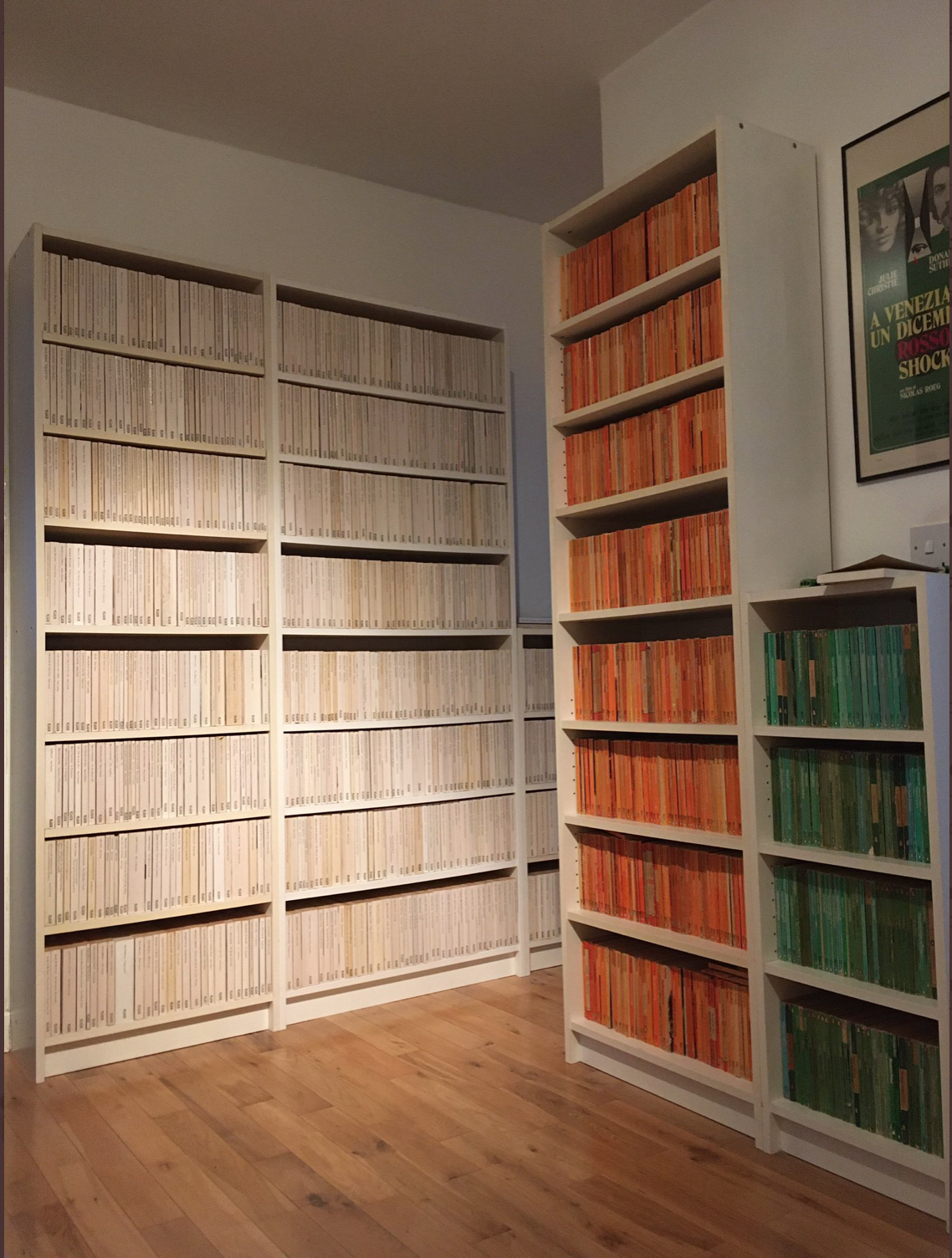
I mention this because overheard conversations about books are included in Royle's "White Spines." And I mention the author alphabetical and random number generation as examples to prove that it isn't only Royle who is obsessed by getting things right coupled with the excitement of luck and coincidence. Initially, reading "White Spines", where Royle regales the reader regarding his collecting Picador 'white spine' books (I've taken the liberty of using his photograph below), one gets the impression that he's completely bonkers. It's only as you read on and identify with almost every aspect of collecting that you realise you're bonkers too.


Whilst I don't collect certain publishers, reading "White Spines" has made me realise how few Picadors I own. Glancing around now I see I have a couple of Ian McEwan ("The Comfort of Strangers", "Black Dogs"), "The Marvellous Adventure of Cabeza de Vac by Haniel Long, sat alphabetically alongside Anita Loos' "Gentlemen Prefer Blondes", and Susanna Jones' "The Earthquake Bird" (which is out of the date that Royle collects and I see the title on the spine is in blue rather than the usual black on white). There may be others hidden behind (in fact, I later find "The Man Who Mistook His Wife For A Hat" by Oliver Sacks and "Rat" by Andrzej Zaniewski), but this paucity of Picadors makes me feel like a fraud.

In my teens, I was more specific with my collections. I loved the numbered spines of Willard Price's Adventure series of (what would now be called) YA novels, and was deeply uncomfortable when number 13, "Tiger Adventure", followed a different format to those which preceded it. I also loved Ian Fleming's James Bond series, specifically the Triad Panther editions with female models draped over exceedingly large replica firearms. Additionally at that age I bought many Agatha Christie novels, particularly those with covers designed by Tom Adams in the Fontana series (I preferred those with the Fontana logo at the top on a white background, with "Agatha Christie" and then the book title underneath, with the artwork underneath that). Sadly, both the Fleming and Christie titles I car booted in bulk fifteen years ago, and have spent the past five years steadily buying them back.

According to Wikipedia, Nicholas Royle has had fourteen books published in total (including novels, novellas, short story collections, and "White Spines"), of which I own thirteen and have now read twelve. I need to get this one, at some point, to complete my collection:


Living in Norwich there are several bookstores to choose from. I prefer Oxfam on Magdalen Street which unlike the Oxfam Books & Music Store on Bedford Street isn't a dedicated bookstore and this is reflected accordingly in more favourable prices. It's been a while since I was in the Tombland Bookshop (lovely building, but somehow I find it off-putting for no particular reason), and whilst I used to buy regularly from the J R & R K Ellis bookshop on St Giles (where I am sure I would find some Picadors) I haven't done so for quite some time (I wonder if the floorboard between the shop's two rooms still squeaks?). The bookstore I wish still existed was The Scientific Anglian on St Benedict Street, which was packed to the rafters with books in precarious states of arrangement. The owner, Norman Peake, was described as a Cretaceous geologist and bookseller whose work on the stratigraphy of the English chalk was truly ground breaking. Those who staff the Oxfam stores may have equally focussed lives, but these are less worn on their sleeves. And at least they never write the price in biro in the top right hand corner of the cover and then draw a box around it.

"White Spines" mentions Nicholas Royle's namesake, another Nicholas Royle who is equally an author, as well as several other examples of author duality. I am reminded of my own namesake, the Andrew Hook who - unlike me, is a professor - and writes non-fiction (most recently, "From Mount Hooly to Princeton: A Scottish-American Medley"), who also gives his name to the Andrew Hook Centre for American Studies in Glasgow), and who - also unlike me - has a dedicated Wikipedia page. Goodreads also provides a third Andrew Hook - unless the Scottish Hook has a predilection for writing erotica as well as non-fiction, whose titles include "Hot Vacation: Naughty Friends #1" and - presumably - the equally hot #2. Finally, I see there is a non-author Andrew Hook who is a Geography lecturer at the University of Sussex where - rather bizarrely, perhaps - Nicholas Royle's namesake also holds residence. To my knowledge, none of us have ever been mixed up.


When Nicholas Royle's publishing venture, Nightjar Press, published my short story, "Throttle Body" as one of their chapbooks last year, Royle came to my house whilst I signed the 200 copies and I noted his eyes roving the few Picadors on my shelves. Having already been aware of his collection prior to reading "White Spines", I mentioned that whenever I saw a Picador in a secondhand book I would think of him and wonder if he had it, but that I wouldn't dream of buying it and passing it on because presumably it would suck all the joy out of collecting. As expected, Royle agreed.

Finally, Royle also mentions in "White Spines" the delight in finding what he has come to call "inclusions" - whether bookmarks, receipts, concert tickets, or otherwise that people tend to leave inside books and which - for some odd reason - booksellers also tend not to remove. I've never had much luck with inclusions - I'm obviously not buying enough books - or perhaps not enough Picadors - however my best example probably couldn't be bettered. In New York around 2004 I visited the vast Strand bookstore and picked up a copy of Jonathan Carroll's "Sleeping In Flame" (Vintage) that sometime afterwards I realise included a short religious pamphlet and a photograph of a girl in some kind of traditional dress. If anyone knows this kid and wants the photo back, drop me a line.


"White Spines: Confessions of a Book Collector" is published by Salt Publishing, is highly recommended, and can be purchased - new - direct from the publisher, here.


Tuesday, 25 April 2023

An Absence of Ghosts

My short story titled "An Absence of Ghosts" has just been published in Theaker's Quarterly Fiction #73. As usual, I'm blogging a few words discussing how the story came to be written. There may be spoilers within.

This story developed from a couple of sources. Firstly, I tend to like trashy horror films but get bored of the tropes. I remember watching "Wrong Turn" and thinking why not make a movie called "Right Turn", where a bunch of teenagers take the better turning and get safely to their destination within a few minutes, with the remaining 90 minutes of the film just credits. Around that time, horror author/editor Johnny Mains was putting together an anthology called "An Obscurity of Ghosts" (featuring forgotten tales of the genre). That make me think how I might write a ghost story, and contrary me came up with "An Absence of Ghosts". The idea, therefore, was to write a story that subverted the usual tropes by having nothing happen. Or, as Stephen Theaker has better phrased it in promo for this edition of the magazine, "From Andrew Hook we have An Absence of Ghosts, about a trip into the mountains where the eeriest things keep not happening."

In my story, therefore, a group of American late-teenage kids keep getting into scrapes where it might appear a horror trope is being set up, only for it to come to naught. Personally, I think this is quite funny (although I do have quite an oblique sense of humor). That doesn't mean that the story isn't also unnerving. Fellow writer, Andrew Humphrey, who I always exchange new stories with, agreed: "I love the constant undercutting of horror movie tropes, but, despite this, you still manage to build a tangible sense of dread. I still kept thinking that something awful would happen and that indeed would also have been a trope!"


Here's a bit of it:

Scott shouts ahead. “Wait! Some ground rules. Check our cells work, don’t split up, turn on any lights if they’re working, if we have to run don’t fall over, and if we do end up getting chased when we reach the highway, don’t run down the centre of the road when being pursued by a car.”

They laugh.

“We’re safe,” Francine says, “because Jessie isn’t here. She’s the shy one. She’s the final girl. If she’s not with us, then this can’t turn out bad.”


As well as the aforementioned "Wrong Turn", I also riff off "A Nightmare on Elm Street", "Carnival of Souls", "Psycho", "The Blair Witch Project", "Candyman", "From Beyond The Grave", "The Babadook", "Ringu", and "Wolf Creek, amongst others. See if you can spot them all.

Theaker's Quarterly Fiction #73 is edited by Stephen Theaker and John Greenwood and is published through Theaker's Paperback Library. The magazine is free to download in epub and pdf, and as cheap as they can possibly make it to buy on Kindle and in print. The best link to check out all purchase options is here. This issue also features stories by Patrick Whittaker, Charles Wilkinson, Harris Coverley and Ross Gresham plus reviews.

As regular readers are aware, I write my short stories listening to music on repeat. In this case, throughout the entire writing session, I played "Jezebel Spirit" by David Byrne & Brian Enoon a loop. Not sure how many times I heard it, but it was quite a few.

Tuesday, 28 March 2023

Creating Time To Write Short Stories

Creating time to write when holding down a full time job and also working several part-time jobs around the full time job can be a tricky business. Since I've been writing short stories for some time now (with over 175 published) I've got to the stage where most of them can be completed in one sitting. But how best to create the time to do so?


For the past few years, I've answered that question by retaining around ten days of my day job annual leave which I then take each February and March, effectively working four day weeks for two months. I book off each Wednesday which works best for me (a Monday or Friday would just feel like part of the weekend and I wouldn't be so focussed). On that Wednesday I sit down at 9am and treat it as though it were a job. A job blessed with creativity.


On previous years, that's yielded five or six new stories (some of the Wednesdays are spent with associated writing matters, like submissions, hunting for an agent, or working on either Salò Press or Head Shot Press books). However, this year, having cleared other matters solely to write, I've managed to create SIXTEEN short stories in those two months!


It has been a little easier than some years because one of the collections I'm working on is intended to be forty stories of exactly 1000 words in length, so whilst that doesn't mean they are easier to write, there are certainly less words to get written. Out of the sixteen stories, eleven have been of 1000 words. And for some of those I've also created time from 7am to 10am on a weekend morning, before anyone else in the household has properly stirred.


In addition to those pieces, I've written three stories which will complete one collection I'm now in the process of seeking a publisher for, and two stories for another new collection of themed stories that I'm working on. This has led to the following word counts: Some Pastel Morning (2108), Sundowning (3877), Inversion Layer (3382), Elevator Pitch (3642), and Betaville (3523). Adding the 11,000 words I've written on the 1000 word pieces means that in total in those two months I've written 27,532 words. Considering these words aren't for one single story, such as a novel, I think that's quite good going for sixteen separate ideas.


You might be wondering, where do all those ideas come from. The fact is, the last short story I wrote was in March 2022, so new ideas have been percolating for quite some time. I keep a folder of short story titles which will gradually coalesce into plots and I draw from those at this time of the year at which point they're ready to just fall out. So the gestation period for them has been quite long. For the 1000 word stories, I've been working off a short prompt for each one (more on this when the project is over), so whilst I only check the prompt a few days before writing the story, it's all ready to go once I'm sat down. Having that definite word count target serves to focus the mind, also enabling the creative process to flow.


I must admit I'm not looking forward to returning to a five day week in the day job. For longer short stories I might build in a handful of writing days for the rest of the year. For the 1000 word stories, I'll continue writing those weekend mornings.


Being creative at this time of the year is perfect for mental health. I start the year in hand, already having written much of my output in the first three months, which - for me - feels like a real spur. And what else would I do with the time when the weather is cold and dull?


I've already booked ten days off for February / March 2024. Let's see what that delivers!


Wednesday, 11 January 2023

The Malaise Trap

My short story titled "The Malaise Trap" has recently been published as a standalone chapbook from the Brazillian-based Raphus Press, and as has become usual I'm writing a few words discussing how the story came to be written. There may be spoilers within.

Like most of my fiction, the idea sprang from the title. I'm fairly certain I became aware of a Malaise trap whilst my partner was writing a themed series of insect poems. I often read facts about insects to her whilst she writes, which lubricates the creative process, and so it's highly likely I heard of a Malaise trap that way. Why? Because it's a large, tent-like structure used for trapping, killing, and preserving flying insects, particularly Hymenoptera and Diptera. It's called a Malaise Trap because it was invented by René Malaise, but - of course - with malaise also meaning a general feeling of discomfort, illness, or unease whose exact cause is difficult to identify, it just begged for a story to be written.

My story centres around an artist using insect photography as part of her work, and her increasingly difficult relationship with her partner, a fledgling novelist, eventually leading to a photograph that might just make her career; but it's more about an outward manifestation of the malaise that dogs that relationship, and how we project thoughts and fears onto others.


Here's a bit of it: 

If Veronika were to collate sufficient exhibits for her show then she needed to eradicate the darkness which occurred in the photographs. The episode with the posterior vitreous detachment had projected her into photography, something she had only been dallying with up to that point. Whilst part of her wondered if she might centre her show with pieces that indicated a veil was being drawn across a field of vision, she decided that anomalies were not true representations of her skills. In fact, it would be the absence of skill that dictated such a show. And that was anathema to her.

The Malaise Trap is published as a limited edition signed dual language (English/Portuguese) hardback chapbook through Raphus Press. It retails at USD$42 including postage worldwide. It can be bought here.

As regular readers are aware, I write my short stories listening to music on repeat. In this case, however, my note is that whilst I wore my noise-canceling headphones throughout the writing of the story, I didn't play any music through them.

Thursday, 29 December 2022

Cumulative quote story

During 2022 I read 70 books. Following each reading, on both Twitter and Instagram, I would post a picture of each book together with what I felt to be a pertinent quote from the contents. As I was devising my end of year list, it struck me that putting all these quotes together might form a short story, so - entirely without embellishment and wholly in the order in which the books were read - here it is. I think there's some really fluid segues! For those interested - which I imagine to be only a few - the titles of those 70 books (together with a list of favourites) is included in my 2022 summary of reading/watching/listening which I previously posted here.


Untitled


Hadn't a man killed himself because someone had stolen this suitcase? And there was nothing in it but an old suit and some dirty laundry.

Afterwards he was so filled with self-disgust that he drank a bottle of pastis straight. He vomited most of it back up, and was furious to find himself still alive in the morning. And the grey, used corpse at his side.

After the terrible flash he had time for one thought: A bomb has fallen directly on us. Then, for a few seconds or minutes, he went out of his mind.

When he was a kid, he imagined the night creatures might think him dead if he lay still enough, and so they wouldn't bother him. The logic of this now escaped him. A dead body was easy prey.

Because I have shown my hands to be empty you must now expect not only that an illusion will follow, but that you will acquiesce in it.

It was a sight as arresting, as unforgiving as watching the death of an animal with which there is no means of communicating.

It was dull to need a map.

The curse of work so stupid you could weep and so interminably monotonous that it made the days too long and, at the same time, life too short.

She watches her mother spill her secrets onto the grass, her father ransacking her insides.

It's easy enough for strong people to despise cowards. But they ought to take the trouble to learn where the cowardice comes from.

I suppose anything is magical that makes you feel like it's possible to have here and there at the same time.

If you was to ask me to point out the most uncivilised area on the face of this globe I would point here.

We don't want to be killed! We don't want to die! We want to live!

It was as if all that had made her who she was had fled at the moment of dying.

No one is more wary than a deranged man who's still lucid enough to realise that he is disturbed.

I was dreaming of the sea. Except everything was mixed up, as if one ocean had run into another. Sea creatures that should never meet ran alongside each other.

Outside a crowd had gathered, because the rumour had circulated in late afternoon that something was about to happen. But nobody had imagined it would be so lacking in excitement.

Forget souls or emotional vibrations, truth is ghosts are closer to ambered flies trapped in their own past.

There were now only families left on the beach, which exuded all the warmth of a summer evening.  A black ship moved imperceptibly across the line of the horizon, entered the sun and emerged on the other side, as if it had jumped through a paper hoop.

How easily she can fell him: and he will always fall.

They may have pitied me for what I was going through, but they had no idea how it felt to suffer something and not know what it was.

The creatures were still motionless in their alcoves, swaddled in their capes of ragged skin, but their heads were raised and flung back now, those blunt muzzles flared open, the teeth splayed, as they howled their grief.

My knees were rubber and my head was full of gravel and my tongue was just an old bar rag. I got up from the window and swayed a moment, holding the wall. Then I turned slowly.

The four people were trapped on the island as though the subject of an experiment conducted by an unknown hand.

Outside, it seemed that the curious silhouette of the convicted criminal was being literally blown around the terrace of the bar.

She wondered if this was such a place, a non-world hidden in the gaps and folds of her own.

'It's not real, any of it. You're crazy. You need help: none of this is real.  It's just - It's stories, nothing but fairy tales.'

'Stories don't change a thing in the end, no matter how many times you tell them.'

The gun made a small flat sound - almost an unimportant sound.

And then his grandmother died and Underhill realised what it was that the flea expected from him.

The dancer had gone back to sleep, her hair tangled, her face gleaming with perspiration. A deep sleep, into which she seemed to have plunged deliberately.

A rainbow is not the light.

He also insisted that her lips remain tight closed during their bedroom scenes, for which he kept on his shoes - 'in case of fire,' he explained.

Rima Cagnac woke, only to learn that she had come close to dying almost eight decades earlier.

After a few minutes of enthusiastic kissing, he pulled away and said, "Are we going to spend all our time necking, or are we going to shoot something?”

To think that this child, this half-being, this imperfectly formed, helpless creature had the audacity - I can't call it anything else - to love and desire with the conscious, sensuous love of a real woman!

The reflection was not enantiomorphic. My buttonhole was on the right. But so was his.

The floor felt warm, worn, hydroptic, apical, pinnate, like the flesh of a vulpine and voluptuous courtesan erotogenically dying.

As I knelt down to slide the laptop between the wardrobe and the wall, I looked at Jane in her red wig and blue dress and put a finger to my lips - Shhh.

The only way we can explore the future is to reinvent the world.

I had become my own quarry at last, the eternally receding object of my own investigations.

He never removed his hand from the glass, except to refill it. His voice was slurred, faltering, lacking in conviction. He looked at no one in particular. He seemed to be melting into the background.

He was amazed by the sheer beauty of that scene, this tall, slender figure, at times almost obscured amid a confusion of sunlit vapour.

I sat back in my seat, letting out a long breath that I didn't realise I'd been holding.

He remained a tall man with short arms and a hundred accoutrements that nobody else could use.

A society that accepts haphazard interrogation and punishment is a society that has become quiescent, and malleable, and safer.

Normally, his hair was a rook's nest of dark copper whorls; wet and slicked back by the water, it looked like eels dipped in rust.

Well it's probably all right. Good old-fashioned pub grub. But, to be honest, £8.50 a meal? I was hoping to pay more.

The woman entered the fire as if it were a swimming pool; she dove in, ready to sink. There was no doubt she did it of her own will. A superstitious or provoked will, but her own.

Saburo never acted by the proposition that if a person did not love someone he would have to be in love with someone else, or that if he loved someone he could not be in love with someone else.

If there's one thing I became sure of in the course of those weeks, it was this: there is no meaning. That is to say, it didn't exist before we did.

Looking back, gathering together this way - somewhere between a half-normal life and the absence of life - was preparing us for what was to come.

Other people are a mystery and unknowable - and the only way you can survive life is through some kind of selective blindness to that fact.

It was sad. So sad that it almost made you want to give up on being a man, on living on this earth, even though the sun shines on it for several hours a day and there are real birds flying freely.

I know now, of course, that this was a stupid thing to think, in so far as most things we believe will turn out to be ridiculous in the end.

Devo's affinity with outsiders and geeks was a major strength of their appeal that drove the success of Freedom.of Choice at a critical moment.

Since I was a boy, I've dreamed about being a cop and living on the moon. But now I'm here, it seems like the party's over and everybody's going home.

I see he's a cardigan which dreamt it was once a man, or a strawberry flan.

Eyes are the only hands some of us have left.

It's totally normal to feel hopeless or worried every now and then, but if it's ruling your life then it's not so normal.

He paced back and forth, leaving the light for the shadow and then the shadow for the light. He gave the impression of a man containing himself, who can remain calm only at the cost of a terrible effort.

He stood back and gave the door a good kick.

Upstairs, I probed you and you felt like the softest tangerine in the fruit bowl.

Brody felt light-headed. His fingertips tingled. He sat down in the chair and drew several deep breaths, to stifle the fear that was mounting inside him.

He had the charm of certain consumptives: fine features, transparent skin, lips that were sensual and mocking at the same time.

Maybe you're better off not asking questions you don't really want the answer to. Just keep pretending this is a fairy tale and leave the hard decisions to the adults.

It was bold and it was brazen, though neither word did her performance justice; masterful: that just about covered it.

He felt a wave of disquiet. It had been a bad break coming across this girl. In combat, like it or not, a girl is your extra heart. The enemy has two targets against your one.

You think I was chasing you. Perhaps it was you who was chasing me from in front. Perhaps we were simply running in the same direction. We each see things in a way that suits our own preference.

Dr Nathan gazed at the display photographs of terminal syphilitics in the cinema foyer. Already members of the public were leaving.